Direct answer
How Should Amazon and DTC Teams Choose an Automatic Pet Feeder?
Choose an automatic pet feeder for an Amazon or DTC launch by matching one configuration route to the channel, price position and support capability before comparing cosmetic options. For most new sellers, the decisive questions are not simply 4L versus 6L. They are whether the product handles the intended kibble without jamming, dispenses repeatable portions, reconnects after network loss, preserves local schedules, supports the destination market and can be serviced after launch. Approve mass production only after the exact sample, app build, time-zone behavior, packaging and agreed inspection plan pass together.
Verified starting point
What the Current LISO Catalogue Shows
- The LISO catalogue contains nine item-numbered automatic feeder entries.
- Catalogue capacities range from 4L to 6L, including one 5.5L format; selected entries show button, Wi-Fi, rechargeable, single-bowl, double-bowl and video-app versions.
- CPC710021 is catalogued as a 6L Video APP feeder, and the catalogue visual shows a dual-power arrangement. The supplied catalogue does not state 1080P, so resolution remains a project-level confirmation.
- The owner-confirmed 9L dual-power video route is not present in the supplied catalogue. It is treated below as an available-on-request route that requires a current item number and specification sheet.
- The owner-described non-Wi-Fi timed route is not labelled mechanical in the supplied catalogue. The exact control architecture must be confirmed before packaging copy is approved.
- Commercial terms and app scope are not inferred from catalogue artwork; they remain model-, market- and customization-dependent.
Catalogue information is not a blanket certification or final production promise. Confirm the exact item and destination-market requirements before publication, quotation, or launch.
Decision 01
Which Feeder Route Fits Your Sales Channel?
A first-time Amazon seller usually needs a lower-risk, easier-to-support configuration; a pet-tech brand can justify video and app complexity; a multi-pet or retail program may need a larger capacity and a more formal service-parts plan. Select the route before selecting colors, packaging or a feature headline.
The cheapest sample is not necessarily the lowest-risk launch. A low-priced Wi-Fi feeder can still create high support costs if pairing instructions are unclear, while a feature-rich video feeder can fail commercially if the brand has no answer for storage, account sharing, privacy, firmware updates or replacement parts. Start with the retail job: target customer, expected selling price, sales channel, support capacity and the reason the product deserves a place in the range.
The four routes below combine owner-confirmed demand with the supplied catalogue. They are not four interchangeable SKUs. The evidence column matters because a buyer should never allow a sales nickname such as “9L visible version” or “mechanical version” to replace an item number, specification sheet and approved sample.
| Route | Best buyer fit | Why it can work | Evidence and next check |
|---|---|---|---|
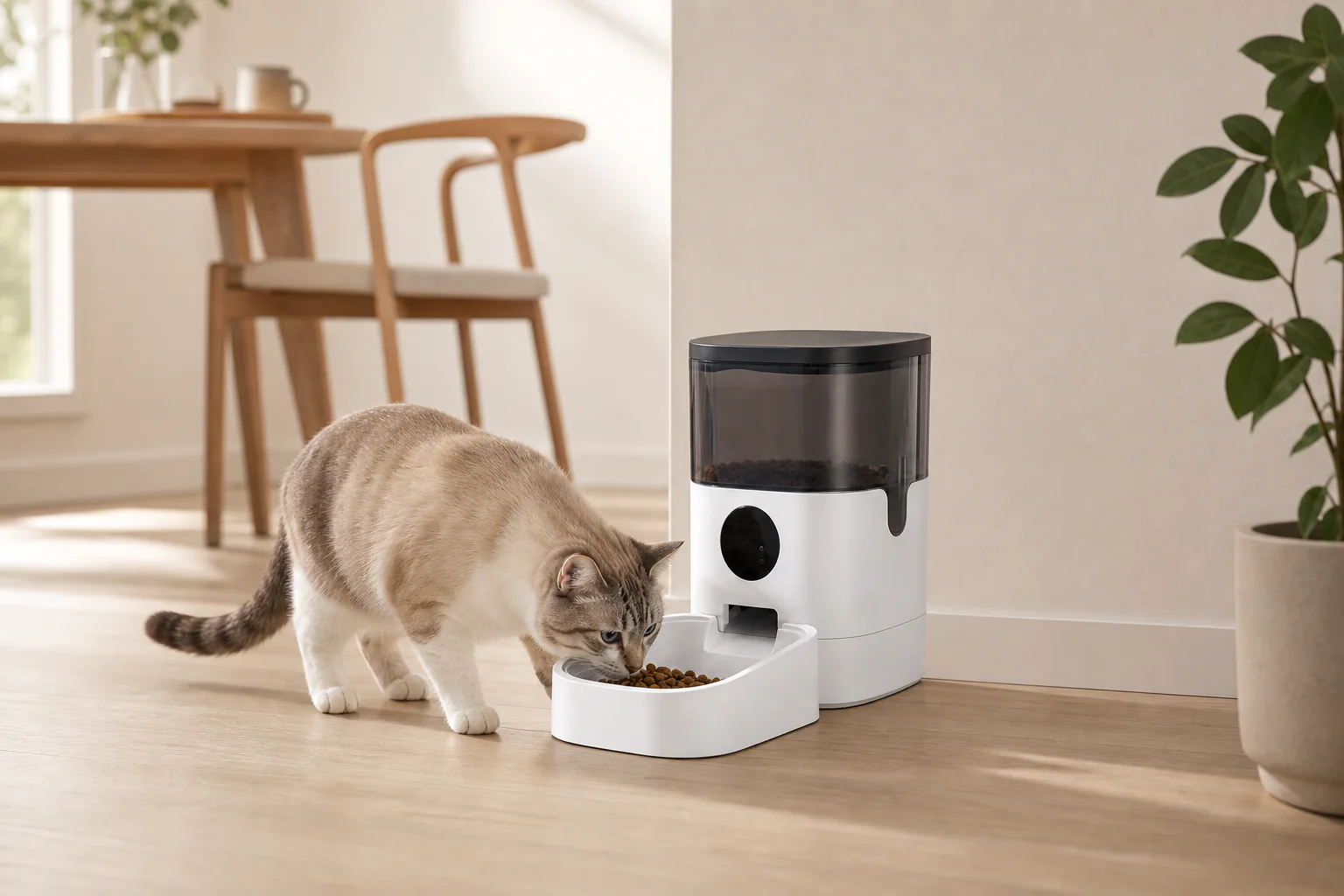
| A · 4L Wi-Fi, no camera | First-time Amazon sellers and value-led DTC launches | Lower hardware and support complexity than a video route while preserving remote scheduling. | CPC710071 is the closest current 4L regular/rechargeable/Wi-Fi catalogue route. Confirm the exact no-camera Wi-Fi version, power format and app scope in the quotation. |
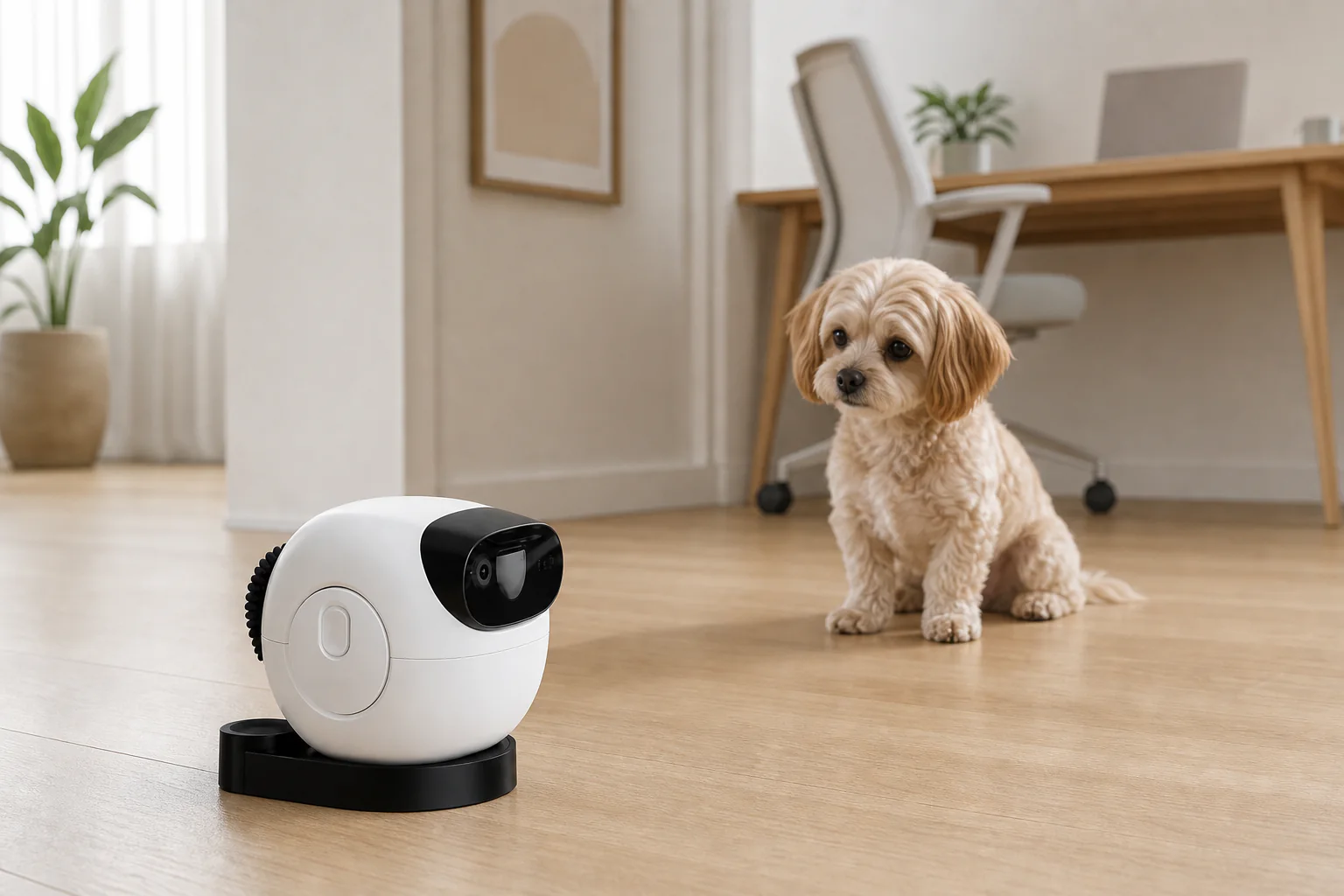
| B · 6L Wi-Fi video-app route | Mainstream cross-border sellers and small pet-tech brands | Combines monitoring and feeding in one proposition and supports a stronger feature story. | CPC710021 is catalogue-confirmed at 6L with Video APP and a shown dual-power arrangement. Confirm effective resolution, viewing angle, storage and app behavior; 1080P is not stated in the supplied catalogue. |
| C · 9L dual-power video route | Multi-pet positioning and North American retail programs | A larger-capacity proposition can support multi-pet and less-frequent-refill use cases. | Owner-confirmed route, but no 9L item appears in the supplied catalogue. Request the current item number, dimensions, carton data, video specification and sample before using it in a range plan. |
| D · Non-Wi-Fi timed route | Offline distributors, value channels and brands avoiding connected features | Simpler end-user support and no dependence on app onboarding. | The catalogue includes regular and button-control variants, but does not identify a mechanical mechanism. Confirm whether the project is an electronic timer or a mechanical design before naming it. |
Decision 02
What Should Buyers Test Before Approving a Feeder Sample?
Test the failure modes that create returns and poor reviews, not only whether one manual feeding command works. Use the intended kibble mix, target router setup, final app build, destination time zone and planned cleaning routine.
LISO’s sample inquiries show a stable order of concern: food jamming comes first, especially with mixed kibble and freeze-dried inclusions; portion deviation comes second; Wi-Fi drops and difficult pairing follow. App lag, hopper moisture, camera blind spots, unstable backup power and awkward disassembly then determine whether a promising sample becomes a support burden.
This order is useful because it prevents the camera resolution, shell color or packaging render from distracting the buyer from the physical feeding job. A feeder that looks correct in a product listing but cannot handle the seller’s target food mix is not launch-ready. The sample plan should reproduce the expected food size distribution, shape, surface oil and freeze-dried ratio rather than relying on one factory test kibble.
Portion testing also needs a written unit of comparison. App “portions” are not automatically grams. Record the food type, target portion setting, number of runs, individual dispense weights, average, spread and any incomplete cycles. If a double-bowl version is being considered, check distribution between bowls as a separate result instead of treating total output as sufficient.
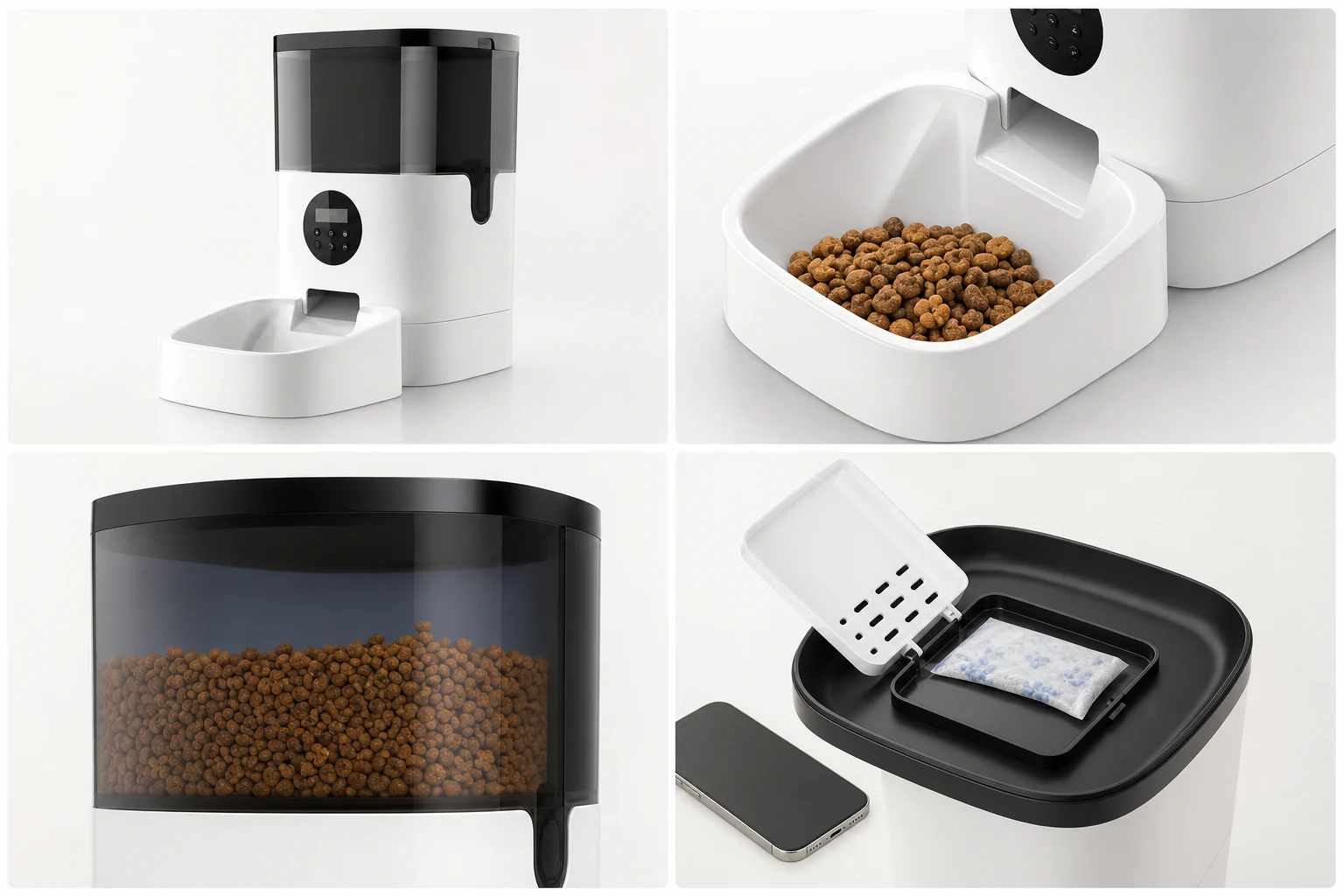
- Run dry kibble, mixed kibble and the intended freeze-dried blend separately; record the particle-size range and the failure definition.
- Measure repeatability across many dispenses, not one successful cycle, and distinguish average error from occasional large deviations.
- Pair the product on representative iOS and Android phones, with a typical dual-band home router, and document the 2.4GHz instruction in the final manual.
- Disconnect and restore power and Wi-Fi separately. Confirm which schedules remain available, how the device reports offline status and how it reconnects.
- Check the hopper seal after a high-humidity exposure relevant to the project, then inspect for visible condensation, clumping and changed dispense behavior.
- Test camera framing at the expected floor and bowl position. A camera can be technically functional while still leaving the bowl or pet outside the useful field of view.
- Ask an unfamiliar tester to remove, clean and reinstall food-contact parts using only the proposed manual. Record where the process is confusing.
Decision 03
How Are LISO Internal Production Checks Structured?
For current standard mass production, LISO combines 100% appearance and assembly inspection with defined sampling for feed cycles, Wi-Fi stability, aging, drop and humidity checks. These are LISO internal production controls, not third-party certification.
The inspection plan below is a starting point for the current standard feeder program. It should be written into the project’s approved quality file with the exact model, firmware version, food medium, environmental setup, failure definition and handling of failed samples. A percentage without a method can create false confidence, and a method used on one feeder route does not automatically validate a different motor, rotor, camera or power architecture.
Third-party sample reports, incoming-material records, aging photos or video, functional-test records and packaging-inspection evidence can be shared for an approved project when available. Full raw factory records, confidential BOMs, customer-owned molds and unreleased client-branded samples are not public evidence. This protects both buyer confidentiality and the meaning of the proof that is shown.
| Check | Current sampling / duration | Internal acceptance point |
|---|---|---|
| Appearance and assembly | 100% inspection; visual check plus manual assembly/disassembly | No visible scratches, even gaps and no loose accessories. |
| Feeding-cycle function | 3% sample; 1,000 continuous cycles | Jam failure rate below 1%; single-dispense weight deviation within ±5% under the agreed test method. |
| Wi-Fi configuration stability | 10 units per batch; powered and connected for 72 hours | 100% successful reconnection in the defined 24-hour offline/reconnect check. |
| Powered aging | 5 units per batch; 48 hours of standby plus scheduled feeding | No crash and no abnormal motor noise. |
| Simulated logistics drop | 5 samples; 1-meter drop on three faces | No cracked housing and normal function after the test. |
| Moisture-seal check | Sample held closed for 72 hours in the agreed high-humidity setup | No obvious moisture return or condensation inside the hopper. |
Decision 04
What Must Be Validated in the Tuya App and Firmware?
Validate the exact branded app build and firmware as part of the product, including pairing, languages, account sharing, offline schedules, storage, updates and time-zone behavior. A platform capability is not proof that every function is enabled correctly in one feeder project.
The current LISO app route uses a third-party Tuya white-label foundation. Owner-confirmed project capabilities include 2.4GHz Wi-Fi rather than 5GHz, English, German, French, Spanish and Italian, multi-account device sharing, local preservation of scheduled feeding when the internet is offline, SD-card video storage, optional paid cloud storage and remote OTA firmware updates. Tuya’s official documentation separately confirms the platform concepts of branded OEM apps, device sharing, local schedules that can execute offline and OTA delivery.
Those platform documents explain what the ecosystem can support; the approved feeder sample must prove what this project actually does. Confirm the app name, logo, store-account ownership, privacy-policy owner, supported operating-system versions, language quality, account-transfer flow, notification wording, device-sharing permissions, subscription presentation and escalation path. For camera routes, confirm whether recording is local, cloud-based or both, how the SD card is formatted and what a user sees when cloud service is not purchased.
Pairing deserves its own acceptance test. The product supports 2.4GHz, not 5GHz. The final packaging and manual should state that requirement before the user reaches the error screen. Test common combined-SSID routers, separate 2.4GHz/5GHz SSIDs, weak-signal behavior, password errors, factory reset, ownership transfer and reconnection after router replacement.
- Create test accounts located in the United States, at least one EU market and the United Kingdom.
- Verify automatic and manual time-zone changes, daylight-saving transitions where applicable and behavior after the phone changes region.
- Create schedules while online, then disconnect the router and confirm the device executes the locally stored plan.
- Share the device with a second account, remove access and confirm the receiving account no longer controls it.
- Run an OTA acceptance sequence on designated samples before approving a mass update path.
- Document which party owns app-store releases, privacy text, cloud-service billing and post-launch bug escalation.
Decision 05
What Did a Missed Time-Zone Requirement Cost One DTC Launch?
In one anonymized DTC project, the buyer approved the hardware appearance but did not validate time-zone synchronization or the app’s target-market time logic. The omission was discovered only after 30% of mass production, forcing firmware rework, extra airfreight and a delayed launch.
The feeder’s project logic defaulted to UTC+8 and did not automatically translate feeding times for the customer’s local market as expected. After products reached users, scheduled feeding appeared at the wrong local time and generated negative reviews. The factory could correct the firmware, but by then the correction was no longer a simple sample-stage change: produced units had to be reworked, delivery planning changed and the buyer paid for faster transport to recover part of the schedule.
The lesson is not that local schedules are unreliable or that a Tuya route cannot support global markets. The lesson is that “offline schedule works” and “the schedule is correct in every target time zone” are two different acceptance criteria. One tests whether the task is stored and executed locally; the other tests how the app, cloud, device clock, firmware, region and daylight-saving rules interpret the time.
A disciplined buyer therefore adds a regional time matrix before production approval. Create the same schedule in representative US, EU and UK accounts; test winter and summer clock rules where relevant; change phone region and time zone; remove internet access; restore power; update firmware; and confirm that the device, app event log and user notification all describe the same local feeding time.
Decision 06
Which Customizations Are Suitable for Private Label, OEM and ODM?
Logo, shell color, color-box packaging, regional plugs, multilingual manuals, app branding and limited firmware parameters can be scoped on existing platforms. A new mold is a different development class with higher MOQ, longer lead time and more validation work.
For an Amazon or DTC market test, the most efficient route is usually to keep the proven public-mold hardware stable and change only what the listing and unboxing experience require. Logo printing, a controlled shell color, retail color box, local plug, multilingual manual and an agreed app route can create a coherent branded offer without changing the food path, electronics or tooling.
App white-label work is more than replacing an icon. It introduces app-store assets, privacy text, account ownership, release coordination, language review, panel configuration, firmware binding and post-launch responsibilities. Firmware parameter tuning also needs a written change list and regression test because a small adjustment to feeding, motor, notification or time logic can affect previously approved behavior.
A new mold should be treated as ODM development rather than “another customization option.” It can change structural fit, food path, sealing, cleaning, tooling validation, packaging dimensions and the evidence required before production. Owner reference indicates private-mold development can add roughly 30–45 days, but the actual schedule depends on design maturity, tooling complexity, component availability and the number of sample rounds.
| Customization | Typical project class | What must be confirmed |
|---|---|---|
| Logo and shell color | Simple OEM on an existing platform | Artwork, color standard, surface process, placement, durability and approval sample. |
| Color box and manual | Simple OEM / market localization | Dieline, claims, languages, warnings, barcode, plug and final packed-product inspection. |
| Regional plug | Market configuration | Plug type, adapter rating, covered model, destination documentation and carton contents. |
| Tuya white-label app | Software-enabled OEM | App ownership, branding, languages, panel, data/privacy responsibilities, store release, storage and support. |
| Firmware parameter tuning | Controlled engineering change | Change list, version control, regression cases, time-zone behavior and approved production firmware. |
| New mold | Heavy ODM | Item definition, tooling ownership, MOQ, development schedule, validation plan and change-control process. |
Decision 07
How Should MOQ, Samples, Lead Time and Warranty Be Quoted?
Quote commercial terms against one item number, destination market and customization scope. LISO does not use one public MOQ or one lead time for every feeder because stock position, app work, packaging, molds, quantity and components change the project.
As a planning reference, neutral in-stock samples can usually be prepared in approximately 3–7 days. A simple OEM project such as logo plus color box can often support a lower MOQ than an app-white-label or private-mold project. Private tooling can add about 30–45 days before mass-production timing is considered. These are scoping references, not fixed commitments; the quotation and project schedule remain the controlling documents.
The standard warranty reference is typically 12 months, with negotiation possible for larger accounts. A useful warranty discussion defines the start point, covered failures, excluded misuse, evidence required, replacement-part route, credit or replacement method, freight responsibility and software-support boundary. A number without a process is not a complete after-sales plan.
Stable spare-part supply is especially important for DTC and marketplace sellers because the seller owns the customer review after the factory shipment is complete. LISO can support stainless-steel food bowls, dispensing rotors or paddles, power adapters, desiccant boxes, upper lids and connection cables for current programs, subject to the exact model and order plan.
- Ask for the neutral sample, branded sample and golden production sample as separate milestones when customization is involved.
- Freeze the item number, firmware version, packaging revision and accessory list before the final pre-production approval.
- Add an initial spare-parts quantity and replenishment method to the purchase discussion rather than waiting for the first return.
- Do not publish MOQ, sample time, bulk lead time or warranty on a marketplace listing until the project quotation confirms them.
Decision 08
What Should Be Included in an Automatic Feeder RFQ?
A qualified RFQ should identify the buyer, channel, destination markets, chosen route, food profile, software scope, customization class, evidence needs and commercial assumptions. This lets the factory answer with a comparable item-level proposal instead of a generic catalogue price.
Start with one primary route and one fallback. For example: “US-first Amazon launch; 4L no-camera Wi-Fi route; target dry kibble plus up to an agreed freeze-dried ratio; 2.4GHz Tuya app; English launch with German and French planned; logo, shell color, US plug, color box and manual; neutral sample first.” That statement is more useful than “send best smart feeder price” because it exposes the decisions that change the sample and quotation.
Attach the intended food specification, target retail positioning, packaging constraints, required market documents and expected support model. For video routes, add resolution, viewing angle, storage, subscription, account-sharing and privacy requirements. For connected routes, attach the regional time-zone test matrix and name who will approve the app and firmware.
Finally, ask the supplier to separate catalogue-confirmed facts, owner-confirmed project options, quotation-dependent commercial terms and items that need engineering confirmation. That separation should continue through the specification sheet, golden sample, purchase order, inspection record and product page.
- Company, sales channel and destination countries: US first, then named EU markets and the UK.
- Target item number or configuration route, capacity, bowl layout, camera and power architecture.
- Food type, particle-size range, mixed-kibble or freeze-dried ratio and proposed sample test.
- App route, languages, account sharing, local schedule, storage, OTA, time-zone and privacy responsibilities.
- Logo, shell color, packaging, plug, manual and any firmware parameter change.
- Expected quantity, launch window, stock/public-mold status and whether a new mold is required.
- Required product, radio, electrical, food-contact, battery, labeling and transport evidence for each destination.
- Internal inspection plan, third-party sample report needs, golden-sample sign-off and spare-parts list.
- Model-specific MOQ, sample timing, bulk lead time, warranty and after-sales handling.
Buyer FAQ
Frequently Asked Questions
Which automatic pet feeder is best for a first Amazon launch?
A 4L Wi-Fi no-camera route is often the lower-complexity starting point for a first Amazon or value-led DTC launch, provided it passes the intended food, portion, pairing, offline-schedule and cleaning tests. The best choice still depends on target price, support capacity and destination market; do not select it from capacity alone.
Is CPC710021 confirmed as a 6L camera feeder with 1080P?
The supplied catalogue confirms CPC710021 as a 6L Video APP feeder and visually shows a dual-power arrangement. It does not state 1080P. Confirm effective resolution, viewing angle, recording and storage on the current specification sheet and sample before using 1080P in product copy.
Does LISO currently have a 9L automatic feeder in the catalogue?
The owner has confirmed a 9L dual-power video route for multi-pet and North American retail programs, but no 9L item appears in the supplied catalogue. Ask for the current item number, specification sheet, dimensions, carton data and sample before adding it to a public range.
Will a Tuya automatic feeder keep feeding when Wi-Fi is offline?
The owner-confirmed LISO project route stores scheduled feeding locally, and Tuya documents that local schedules can execute without a cloud connection. The exact feeder, firmware and schedule behavior must still be validated on the production-intent sample, including power loss, reconnection, time-zone and daylight-saving cases.
What food-jam and portion tests should an importer request?
Use the intended dry kibble, mixed kibble and freeze-dried blend; define particle size and failure criteria; run repeated cycles; weigh individual outputs; and record jams, partial feeds and large deviations. LISO’s current internal production reference uses a 3% sample over 1,000 cycles with jam failure below 1% and single-dispense deviation within ±5% under the agreed method.
What can be customized on a private-label automatic pet feeder?
Supported scope can include logo, shell color, color-box packaging, country-specific plugs, multilingual manuals, Tuya white-label app branding and limited firmware parameter tuning. A new mold is supported as heavy ODM but requires a higher MOQ, longer development time and a separate validation plan.
What is the MOQ and lead time for an OEM automatic pet feeder?
There is no one fixed figure for every project. Neutral in-stock samples are typically a 3–7 day planning reference; simple logo-and-box OEM can have a lower MOQ; app white-label and new molds add work; and private tooling can add roughly 30–45 days. Confirm the exact item, quantity, stock position and customization in the quotation.
External validation
Research and Official References
Official sources define regulatory, safety, security, material or transport questions. Competitor sources show customer-support expectations. Neither proves model-specific LISO performance or compliance; those claims still require an approved sample, specification and project record.
- Tuya Developer Platform — OEM AppOfficial platform reference for branded OEM app creation and configurable brand properties.
- TuyaOS — Local ScheduleOfficial reference explaining that a local schedule is downloaded to the device and can run offline.
- Tuya Developer Platform — SmartLife App OverviewOfficial platform overview covering permission management, localization and device sharing.
- Tuya Developer Platform — Update FirmwareOfficial OTA reference; actual device support depends on the approved hardware and firmware implementation.
- Tuya Developer Platform — Device PairingOfficial troubleshooting reference for 2.4GHz pairing and common router conditions.