Direct answer
How Should a Pet Brand Evaluate a Treat-Dispensing Camera?
Approve a pet camera with treat dispenser only after the treat mechanism and the camera system pass as one product. First define the intended treat size, shape and texture; then test jams, dose variation, launch direction, stability, cleaning and pet access. Separately validate useful field of view, low-light video, audio, notifications, account behavior and the final app build. A 1080p label or one successful toss does not predict the return risk of an Amazon or DTC launch.
Verified starting point
What the Current LISO Catalogue Shows
- The current LISO catalogue contains five item-numbered treat-dispensing camera concepts.
- CPC710053 is listed with a 320ml treat capacity, 1080p video, two-way audio, night vision, 360-degree movement, AI tracking, treat tossing, an anti-jam feature and detachable food-contact parts.
- CPD810025 and CPPTY185 are battery-powered movable concepts; their battery and standby statements require exact sample and transport-document confirmation.
- CPC710052 lists 2.4GHz / 5GHz Wi-Fi plus Bluetooth, while other models do not share one catalogue-wide connectivity statement.
- Catalogue fields describe the model shortlist. Treat compatibility, launch distance, useful viewing angle, app behavior and production acceptance still require item-specific approval.
Catalogue information is not a blanket certification or final production promise. Confirm the exact item and destination-market requirements before publication, quotation, or launch.
Decision 01
Which Product Job Should the Treat Camera Own?
Choose one primary job—remote reward, mobile interaction, fixed-room monitoring or a giftable pet-tech experience—before choosing a body shape. Each job creates a different sample test and support burden.
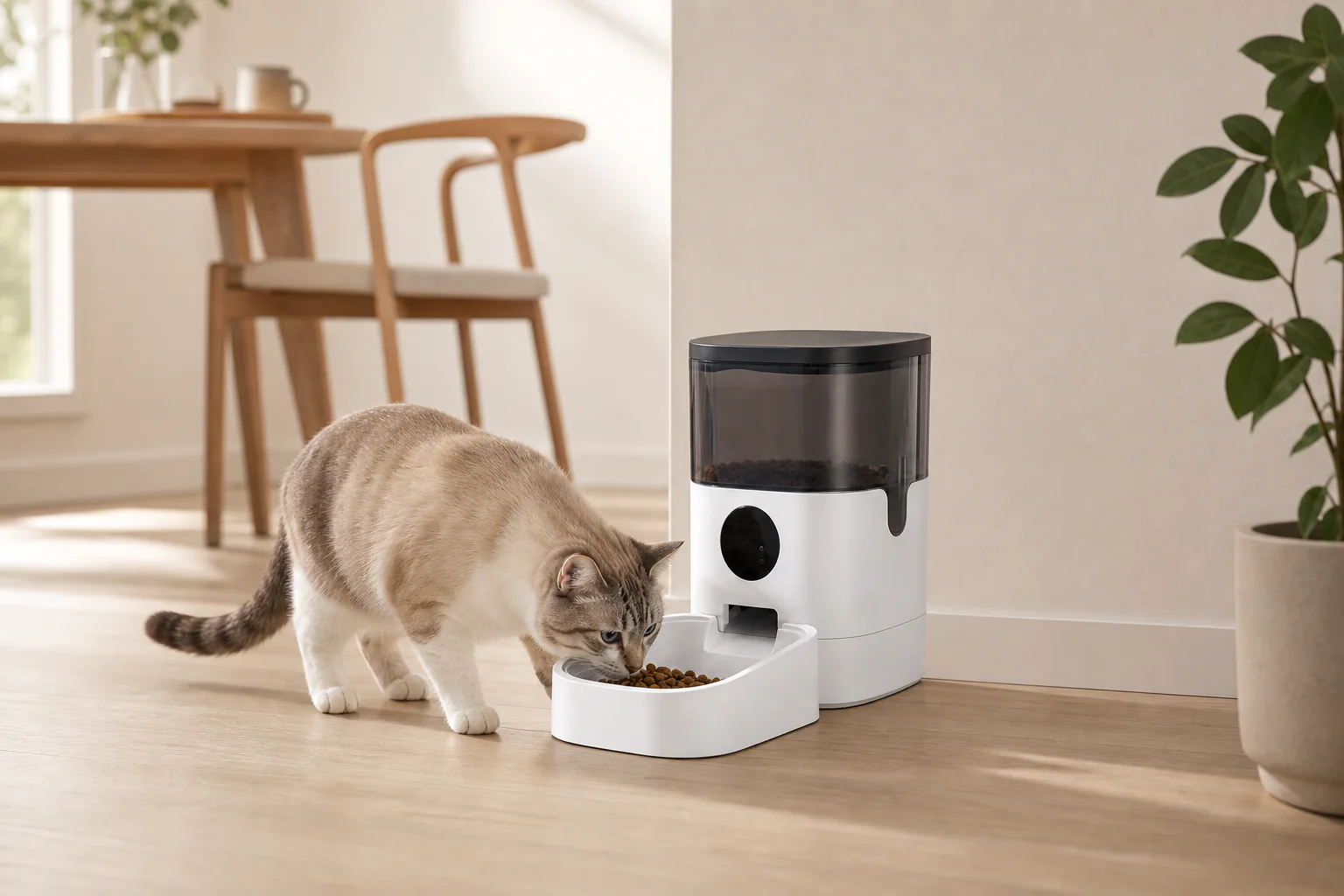
Consumer brands usually lead with the emotional moment: see the pet, speak to it and toss a treat. Petcube and Furbo use this pattern effectively, then support it with treat-size guidance, placement instructions, cleaning information and app onboarding. For a private-label buyer, those support details are more important than copying the emotional headline because they reveal what customers will ask after purchase.
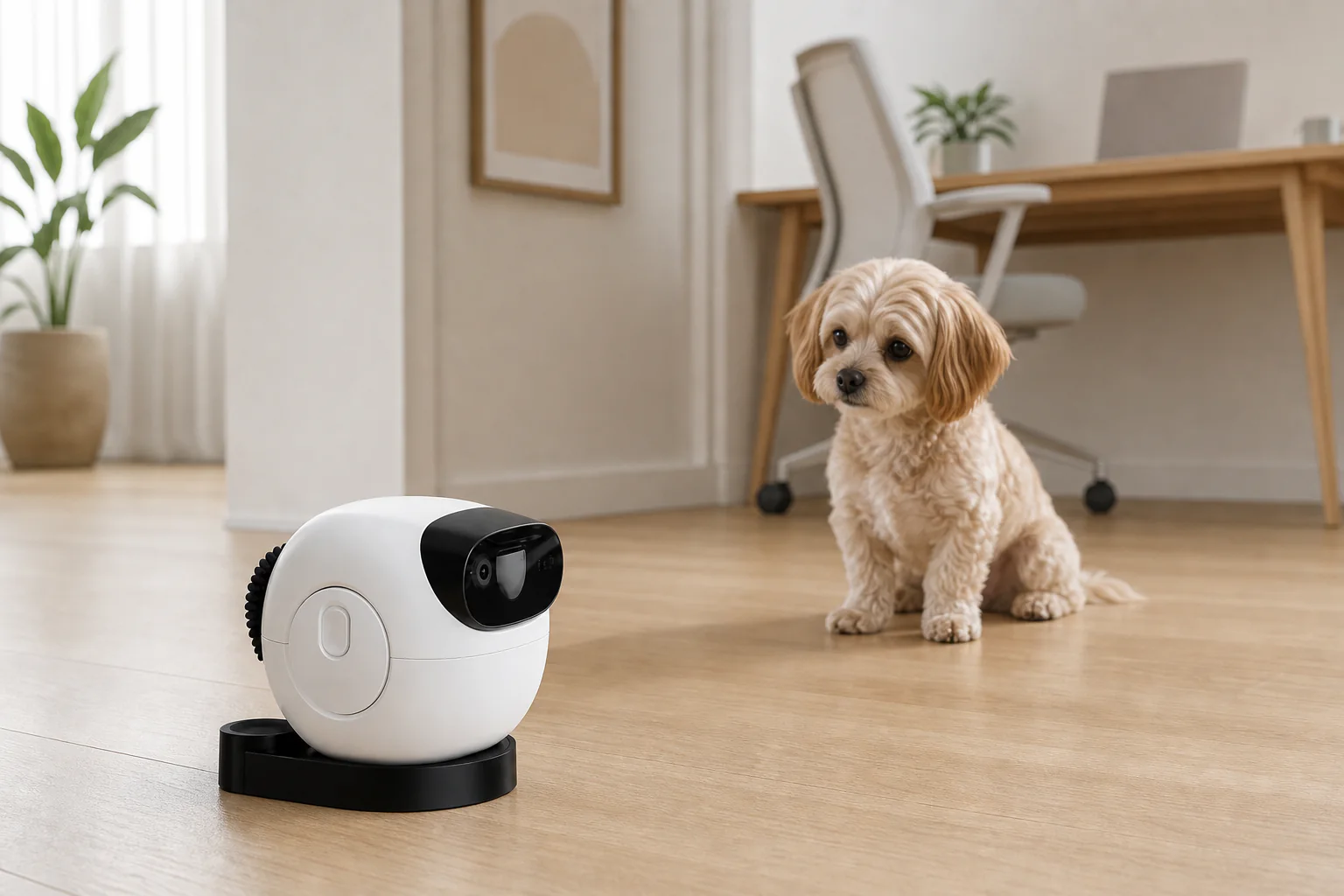
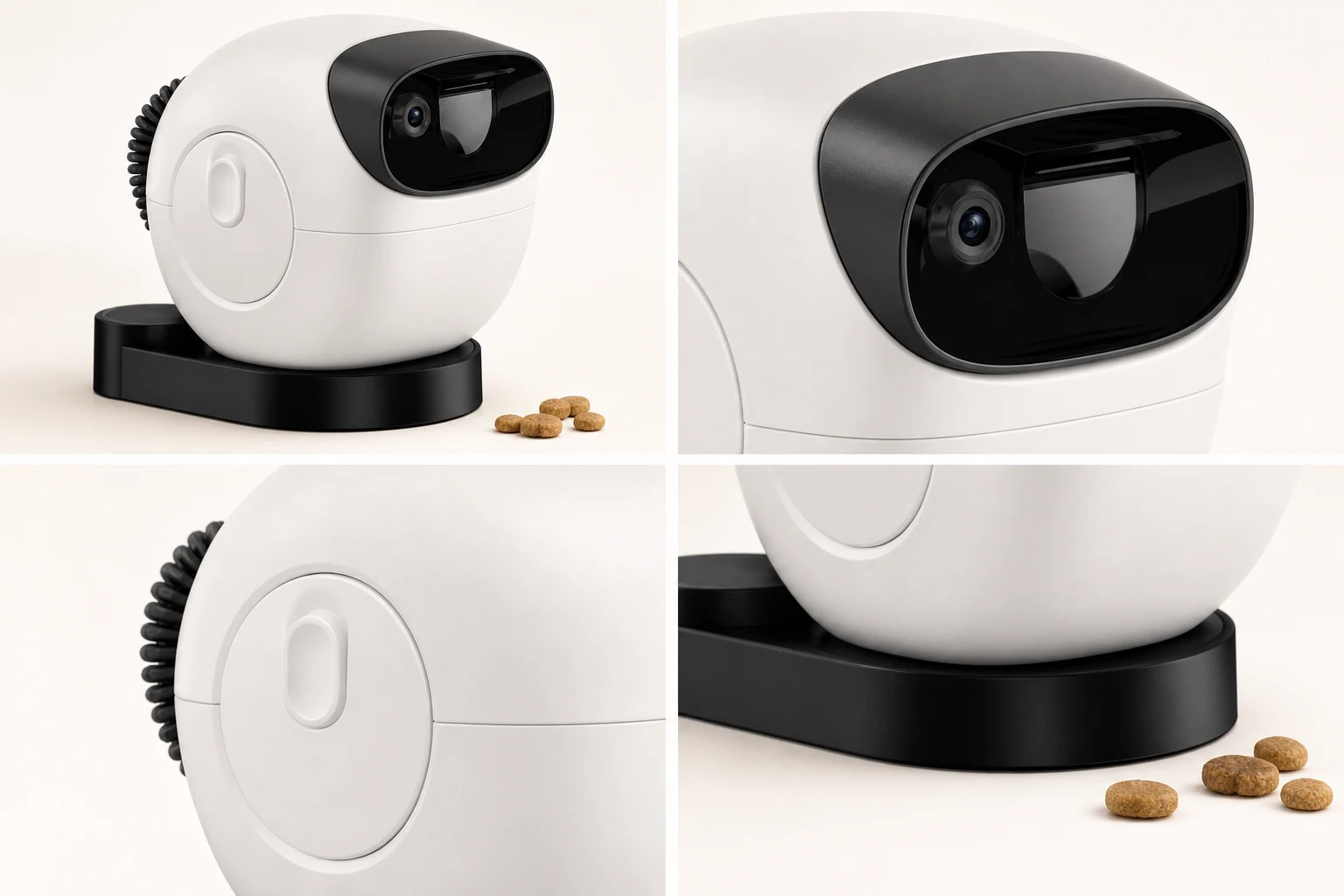
A fixed treat camera can be easier to stabilize and explain, while a movable or tracking camera adds motors, batteries, obstacle behavior and a larger software surface. A distinctive OWL or ROCKET body can help a gifting assortment stand out, but appearance does not remove the need to document treat compatibility, refill access, cleanability and the route for replacement power parts.
The commercial decision is therefore not “which model has the most features?” It is “which promise can the brand demonstrate, explain and support in its target channel?” A first Amazon listing may benefit from a simpler fixed or 360-degree route with a clear test record. A specialist pet-tech brand may accept greater complexity if movement or tracking is central to its differentiation.
| Item | Catalogue concept | Possible range role | First unresolved question |
|---|---|---|---|
| CPD810025 | Movable dog treat camera | Mobile interaction concept | Battery runtime, obstacle behavior, treat path and the catalogue size/weight fields. |
| CPPTY185 | OWL treat-tossing camera | Giftable or character-led range | Treat compatibility, launch behavior, stability and final app scope. |
| CPC710052 | Voice-control pet camera | Connected-home proposition | Effective video output, IP statement, wireless behavior and voice-platform scope. |
| CPC710053 | 360-degree tracking treat camera | Mainstream feature-led route | Tracking boundaries, anti-jam test method, 320ml usable capacity and cleaning sequence. |
| CPC710054 | ROCKET 360-degree camera | Distinctive pet-tech design | Viewing coverage, dispensing mechanism, mounting stability and software-service scope. |
Decision 02
How Should Treat Compatibility Be Tested?
Build a compatibility matrix from the treats the target customer actually buys. Record size distribution, shape, hardness, surface oil and crumbs, then run repeated cycles at low, medium and near-empty hopper levels.
Treat dispensers fail at the interface between food and mechanism. A hopper can hold the advertised volume but still bridge, crush or double-dispense irregular treats. Competitor guidance shows why brands must define the food envelope: Petcube recommends dry, hard and uniform treats within a stated size range for its own products. That is a useful market-support benchmark, not a specification for a LISO item.
A meaningful sample test needs more than “100 tosses passed.” Define a jam, partial toss, double toss and no-output event. Weigh or count the output, note the hopper fill level and photograph residue around the rotor or exit. Repeat after the device has been left loaded in the intended humidity and after the food-contact parts have been removed and reinstalled by a new tester.
Launch direction also matters. A treat that leaves the device reliably can still hit the camera body, land behind furniture or startle the pet if the throw angle and placement are wrong. Test from the recommended shelf or floor position, with the intended treat and at the distance shown in the manual. Keep the pet out of early mechanical tests; add supervised pet-use observation only after the path is predictable.
| Variable | Test levels | Record |
|---|---|---|
| Treat geometry | Small, target and upper-bound sizes; round and irregular shapes | Jam, no-output, multiple-output and damaged-treat events. |
| Treat condition | Dry/hard target treat, crumb-prone treat and oily surface | Residue, bridging, slip and cleaning effort. |
| Hopper level | Near full, half full and near empty | Whether output behavior changes with head pressure. |
| Placement | Planned shelf/floor height and target room | Landing zone, stability, lens obstruction and pet access. |
| After cleaning | Parts removed, washed as instructed, dried and reassembled | Fit, seal, noise, output and user error. |
Decision 03
Why Is Useful Video Different from Catalogue Resolution?
Resolution is one input. The launch decision should use recorded evidence from the final device position, including the bowl or landing zone, pet-height coverage, low-light performance, motion, audio and network recovery.
A camera can output 1080p and still miss the interaction. The lens may sit too low, the treat outlet may block the pet at close range or the useful zone may fall outside the frame after the device turns. Record representative clips with the camera at the exact planned height and show both a small cat and a larger dog use case when those species are in scope.
For moving concepts, separate physical navigation from video tracking. Ask what triggers movement, what happens near stairs or cables, how the device behaves when blocked, whether tracking can be disabled and how the camera returns to a charging or resting state. A short promotional clip cannot answer these repeatability questions.
Audio needs a similar real-room check. Test talk/listen latency, feedback, volume, alert timing and behavior after switching networks. If the product page will promise night vision or tracking, retain time-stamped sample evidence for the exact firmware rather than relying on a generic app screenshot.
- Record daylight, backlit and low-light clips from the final installation height.
- Confirm that the treat landing zone remains visible before and after any rotation or tracking event.
- Measure notification and two-way-audio behavior on the target iOS and Android versions.
- Disconnect Wi-Fi, restore it and document reconnection, missed events and user messaging.
- Confirm whether resolution refers to sensor capture, encoded stream, recorded file or app display.
Decision 04
What Cleaning and Stability Checks Prevent Avoidable Returns?
The buyer should be able to remove every intended food-contact part without opening the electronics, clean and dry it using the proposed instructions, reinstall it correctly and obtain the same dispensing result.
Cleaning claims must follow the exact model. Petcube publishes product-specific dishwasher temperatures and removable-hopper guidance for its own camera; that shows the level of detail customers expect, but it does not authorize the same claim for LISO. For the shortlisted item, identify which parts are removable, which may be rinsed, which must stay dry and how completely they need to dry before reassembly.
Stability belongs in the same test because pets pull, paw and nose at food smells. Check the base on the surfaces shown in marketing, the lid and refill opening, cord access and whether a curious pet can reach the treat store. If mounting hardware or adhesive is proposed, include it in the packed sample and test removal as well as installation.
A good manual should prevent predictable mistakes: filling with sticky treats, blocking ventilation, washing the motorized body, placing the product at the edge of a shelf or allowing a pet to chew the cable. These are not decorative safety sentences; they are acceptance criteria for packaging, instructions and customer-support scripts.
- Photograph the disassembly order and count the loose pieces.
- Time one first-use cleaning cycle performed only from the draft manual.
- Inspect seals, food residue and trapped moisture after reassembly.
- Repeat the treat matrix after cleaning to detect misalignment or incomplete drying.
- Test base movement, tipping, lid access and cord exposure on the intended surface.
Decision 05
Where Does the App and Security Review Begin?
For a connected camera, the buyer needs a written data-flow and account-support scope before approving packaging. Treat mechanics can pass while the launch still fails on ownership transfer, storage, updates or privacy communication.
Keep the first treat-camera project review practical: identify the app owner, account-registration data, device-sharing rules, video storage route, subscription dependency, reset and transfer flow, firmware-update owner and support escalation path. The separate pet-camera privacy guide goes deeper into NIST, UK and EU expectations, but these basic answers must already be present in the treat-camera quotation.
Do not assume a function belongs to every LISO camera because it appears in another model or in a platform demonstration. Validate the exact item, firmware, app build and destination-market configuration. If the project will use a white-label app, the buyer also needs to allocate ownership for app-store accounts, privacy text, translations, releases and incident communication.
Decision 06
What Evidence Should Be Approved Before Mass Production?
Approve an item-numbered evidence pack: final specification, treat matrix, placement video, cleaning sequence, app/account matrix, packed sample, firmware version, open issues and signed acceptance criteria.
The catalogue establishes which concepts deserve a sample. It cannot serve as the production record because several fields require clarification and because the same-looking body can carry different electronics or firmware. The buyer’s source of truth should be one version-controlled project file tied to the item number and approved sample.
Request only evidence that can be truthfully matched to the project. LISO can discuss assembly-line images, incoming inspection records, aging-test media, functional-test steps, packing inspection and third-party sample reports when available and shareable. Customer molds, confidential BOMs, unreleased logo samples and full raw quality datasets remain protected.
| Evidence | Question it closes | Approval boundary |
|---|---|---|
| Item specification and packed BOM | What exactly is being ordered? | Model, accessories, plug, packaging and declared functions. |
| Treat compatibility matrix | Which treats can the mechanism handle? | Agreed food envelope and failure definitions. |
| Placement and video clips | What will customers actually see? | Final hardware, firmware, height, lighting and network. |
| Cleaning and stability record | Can the product be maintained safely? | Exact removable parts, instructions, surface and mounting. |
| App/account test matrix | Who can use, share, reset and update the device? | Final app build, accounts, storage and support owner. |
| Open-issue log | What has not been proven? | Owner, due date and release gate for every unresolved claim. |
Buyer FAQ
Frequently Asked Questions
What should a buyer test in a pet camera with treat dispenser?
Test treat size and shape, jams, multiple or missed output, landing zone, stability, cleaning, useful video coverage, low-light performance, audio, alerts, Wi-Fi recovery, accounts, storage, reset, firmware and the final packed instructions.
Does a 1080p pet camera guarantee useful video?
No. Confirm what the value describes, then record the final sample from its intended height and lighting. Useful coverage, encoding, app display, motion, storage and network behavior all affect the customer result.
Can competitor treat-size guidance be used for a private-label model?
No. It is a market benchmark showing the detail customers expect. The usable treat envelope must be tested and documented for the exact LISO item and mechanism.
Which LISO treat camera is the default best seller?
The catalogue does not establish a universal best seller. CPC710053 is the strongest current comparison anchor because it lists 1080p, 360-degree movement, AI tracking, 320ml capacity, anti-jam and detachable food-contact parts, but the best route depends on channel, support capacity and approved sample results.
What should be included in a treat-camera RFQ?
Include item numbers, target customer and channel, treat envelope, placement, video and app requirements, account and storage expectations, destination market, quantity, plug, branding, packaging, required documents and the sample acceptance matrix.
External validation
Research and Official References
Official sources define regulatory, safety, security, material or transport questions. Competitor sources show customer-support expectations. Neither proves model-specific LISO performance or compliance; those claims still require an approved sample, specification and project record.
- Petcube — Compatible TreatsCompetitor support benchmark showing product-specific guidance for treat size, shape, texture and hopper use; it is not a LISO specification.
- Petcube — Bites 2 Lite Product SpecificationsCompetitor benchmark for how treat compatibility, cleaning, mounting, connectivity and security are disclosed to customers.
- Furbo — Treat Tossing and Cleaning GuideCompetitor support reference illustrating the need for mechanism and cleaning instructions after sale.
- NIST IR 8425 — Consumer IoT Cybersecurity ProfileOfficial baseline for considering the cybersecurity outcomes of an entire IoT product, including supporting services.