Direct answer
How Should a Buyer Evaluate a Private-Label Pet Water Fountain?
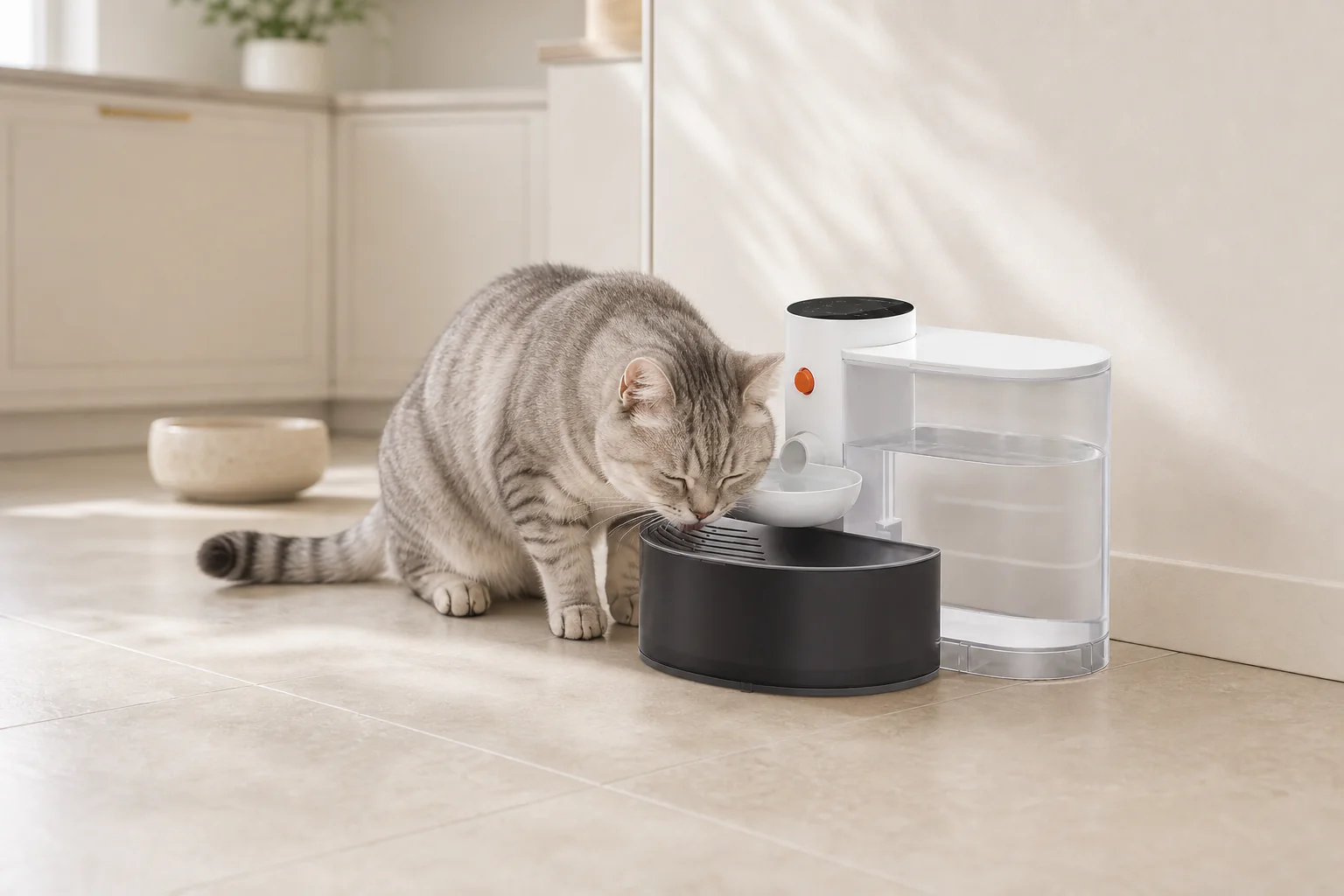
Evaluate a pet water fountain as a service system, not only as a 3L appliance. Trace the complete water path; confirm which parts touch water; disassemble and clean the pump, impeller, reservoir, outlet and filter housing; then verify filter and pump part numbers, replacement availability, packed instructions and destination-market material evidence. The winning model is the one a customer can keep clean and a brand can support after the original filter or pump needs attention.
Verified starting point
What the Current LISO Catalogue Shows
- The LISO catalogue contains five item-numbered pet water fountain formats ranging from 3L to 3.2L.
- CPC750085 is listed as a 3.2L SUS304 stainless-steel format; CPC750084 is a 3L split-design PP format.
- CPC750086 is listed as a 3L wireless ABS format with a battery and automatic water-changing description that requires exact functional confirmation.
- CPC750080 lists ABS + PP, infrared sensing, low-water protection and a 30dB statement; CPC75001 lists PP, low-water cutoff and a 30dB statement.
- Material names, noise values and catalogue functions do not establish food-contact compliance, useful capacity, cleaning frequency, pump life or filter replacement intervals.
Catalogue information is not a blanket certification or final production promise. Confirm the exact item and destination-market requirements before publication, quotation, or launch.
Decision 01
Why Is the Water Path More Important Than Capacity?
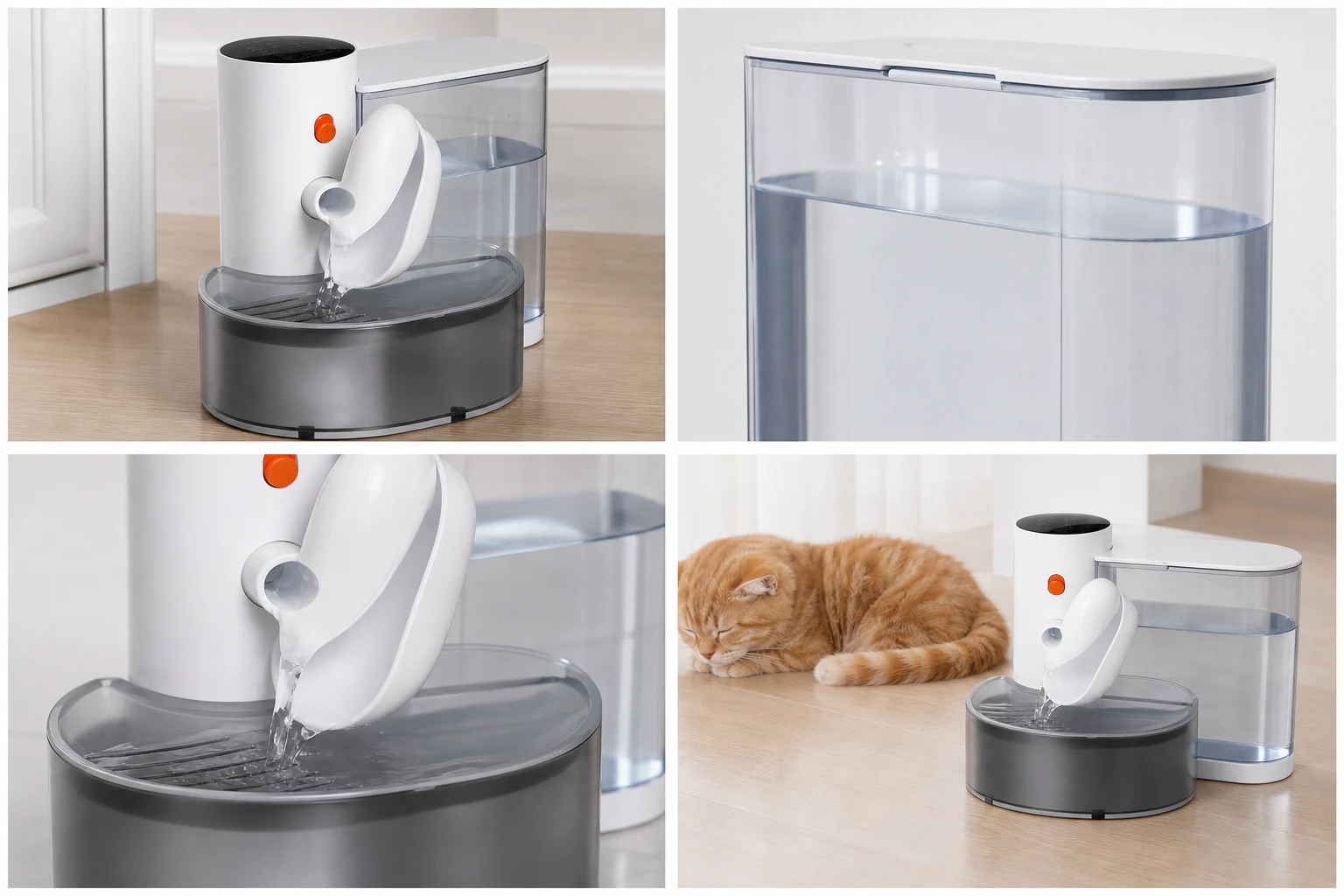
Capacity is a merchandising number. Reliability and cleaning are determined by every reservoir, channel, pump surface, impeller, cable route, filter layer, outlet and seal that water or debris can reach.
Most product pages emphasize capacity, quiet operation and fresh water. Competitor support libraries reveal the after-sale reality: customers need instructions for pump disassembly, mineral deposits, stopped flow, filter replacement and reassembly. PetSafe publishes separate steps for removing and cleaning an impeller, and Petlibro exposes app reminders for filters and pump cleaning. Those patterns show what a private-label support system must be ready to answer.
Start sample review by drawing the water path and labeling every removable component. Pour colored test water through the assembled sample, drain it and inspect where moisture or residue remains. Ask an unfamiliar tester to disassemble and reassemble the fountain from the draft manual. If a brush cannot reach a channel or a small part can be installed backwards, record it as a design or instruction risk.
The path also determines service diagnosis. A customer reporting “the fountain is noisy” may have a low water level, mineral build-up, trapped debris, a mis-seated impeller, an incorrect assembly or an electrical problem. The brand needs a safe troubleshooting tree that separates user maintenance from a part replacement or return.
| Zone | Sample check | Support implication |
|---|---|---|
| Reservoir and lid | Usable fill, low-water line, trapped residue, removal and fit | Clear fill and cleaning instructions; separately available lid if promised. |
| Pump and impeller | Tool-free access, debris/mineral cleaning, alignment, noise and restart | Illustrated pump service guide and exact replacement part. |
| Filter housing | Correct orientation, bypass paths, wet fit and removal | Compatible filter SKU, pack format and replacement instruction. |
| Outlet and channels | Reachability, drainage, splashing and stagnant pockets | Brush access and unambiguous reassembly steps. |
| Power and cable route | Wet/dry boundary, strain relief, adapter and unplug sequence | Market plug, safety wording and no unsafe user repair. |
Decision 02
How Should Pump and Filter Support Be Designed?
Assign stable part numbers, compatibility rules, pack quantities and replenishment ownership before the first production order. Do not make a replacement interval or pump-life claim without item-specific evidence.
Filters and pumps have different service lives and failure signals. A filter may be replaced because of time, water condition or visible loading, while a pump may recover after cleaning or need replacement after a verified electrical or mechanical fault. Combining both into one vague maintenance reminder makes troubleshooting harder and inventory less accurate.
PetSafe’s support pages identify replacement pumps, carbon filters and foam filters by compatible product families. That is a useful commercial benchmark: a customer or agent should not have to compare dimensions from photographs. LISO’s buyer RFQ should therefore specify whether pumps, impellers, adapters, filters, lids and reservoirs can be reordered, the exact covered fountain models and whether packaging can carry the brand’s part code.
A replenishment model also needs channel math. Decide whether filters ship inside the fountain, as a launch bundle, in separate retail packs or through direct-to-consumer subscription. Include carton dimensions, barcode ownership, localized instructions and a plan for discontinued parts. Repeat sales are valuable only when compatibility is stable and stock is available.
| Part | Specify before launch | Do not assume |
|---|---|---|
| Filter | Layers, dimensions, orientation, covered items, pack quantity and brand part code | One filter fits every 3L fountain or one interval fits every water condition. |
| Pump | Electrical rating, connector, flow route, covered items and safe replacement procedure | A visually similar pump is electrically or mechanically interchangeable. |
| Impeller / cover | Whether supplied separately and how it is identified | Every flow problem requires a complete new pump. |
| Adapter / cable | Country plug, rating, connector, cord and covered items | A generic adapter preserves safety, noise and performance. |
| Lid / reservoir | Color, fit, model revision and packaging protection | Body revisions remain compatible indefinitely. |
Decision 03
What Should a Cleaning Test Measure?
Measure access, time, error and recovery. A clean-looking lifestyle photo does not show whether a customer can reach the impeller, dry the parts or restore quiet flow after reassembly.
Run the proposed maintenance cycle with the intended water and representative pet hair or debris. Time disassembly, cleaning, drying and reassembly. Record tools, loose parts, sharp or narrow areas, remaining moisture and whether the pump restarts at the same noise and flow level. Repeat with a tester who has never seen the product.
Official competitor instructions vary by product: PetSafe recommends model-specific cleaning and pump disassembly, and one support page notes that multi-pet use may require more frequent cleaning. Petlibro publishes a two-week reminder for selected smart fountains. These are not universal rules for LISO. They demonstrate that maintenance frequency is product- and use-dependent and must be supported by the exact manual and validation.
Hard-water mineral deposits deserve a separate test because they can restrict an impeller without an obvious electrical failure. A brand can explain a validated descaling method only after confirming compatibility with the exact materials, seals and instructions. Never copy a competitor’s vinegar ratio or dishwasher statement onto another design without model-specific approval.
- Define the safe unplug, drain and disassembly sequence.
- Record the number of removable parts and any parts that can be installed incorrectly.
- Inspect the impeller cavity, filter bypass areas, narrow channels and cable entry.
- Confirm which components can be rinsed, hand-washed or placed in a dishwasher.
- Measure post-cleaning flow and sound using the same setup as the baseline.
- Turn common support findings into illustrated manual steps and spare-part decisions.
Decision 04
How Should PP, ABS and SUS304 Claims Be Verified?
Treat the catalogue material name as a starting point. Map every water-contact component, obtain the relevant material and test evidence for the destination market, and approve public wording only for the exact model and production configuration.
A fountain can combine a stainless-steel visible tray with plastic reservoirs, pumps, tubing, seals and adhesives. Calling the whole product “stainless steel” can therefore overstate the water-contact construction. Create a material map that distinguishes visible housing, water-contact parts and non-contact electronics.
The European Commission states that food-contact materials placed on the EU market must comply with Regulation (EC) No 1935/2004 and applicable good manufacturing practice. Whether a pet-water product or a specific part falls under a particular food-contact rule requires market and product review. The sourcing principle remains useful: material identity and suitable documentation must match the exact item rather than a generic supplier statement.
For the United States, destination-market requirements and intended use must be reviewed separately. Do not translate a resin name, “food grade” phrase or stainless-steel grade into an FDA approval claim. Ask what document exists, which component and batch it covers, the test conditions and whether the proposed colorant or formulation is included.
| Claim layer | Required evidence question | Safe public boundary |
|---|---|---|
| Catalogue material | Which named parts use PP, ABS, SUS304 or another material? | State the listed construction only after item confirmation. |
| Water-contact map | Which surfaces, seals, pump parts, filters and adhesives contact water? | Avoid implying the visible tray is the entire water path. |
| Market documentation | What declaration or test covers the exact component, formulation and use? | Name compliance only after destination-market review. |
| Production control | How are approved resin, colorant and supplier changes controlled? | Do not treat one old report as proof for every future configuration. |
Decision 05
Which of the Five Fountain Routes Fits the Range?
Build a good-better-best range around a clear difference—material, serviceability, sensor experience or wireless placement—not five products that repeat the same 3L claim.
CPC750084’s split PP format can support a value and cleanability proposition if sample disassembly is strong. CPC750085 provides the clearest stainless-steel-led route at 3.2L, subject to a complete water-contact map. CPC750080 adds infrared sensing and low-water protection, while CPC75001 is a simpler PP route with low-water cutoff.
CPC750086’s wireless and battery-led proposition may support flexible placement, but it requires extra battery, charging, runtime, transport and end-of-life questions. The catalogue also uses an “automatic water-changing” description that should not be published until the exact mechanism, reservoir relationship and customer action are documented.
Noise comparisons require a shared method. Two catalogue entries state 30dB, but a number without measurement distance, water level, surface, room noise and sample condition is not a retail-proof comparison. Record the actual sound under the approved setup and use cautious wording unless a substantiated claim is available.
| Item | Range role to investigate | Release gate |
|---|---|---|
| CPC750084 | Value PP / split-design route | Cleaning access, usable capacity, pump/filter parts and material documents. |
| CPC750085 | Stainless-steel-led better route | Full water-contact map, cleaning, fingerprint/scratch review and exact documents. |
| CPC750080 | Sensor-led smart route | Trigger logic, low-water behavior, noise method and service parts. |
| CPC75001 | Simpler PP daily-care route | Low-water cutoff, cleaning, pump/filter compatibility and packaging. |
| CPC750086 | Wireless placement route | Battery, charging, runtime, transport, stated water-management function and service plan. |
Decision 06
What Should the Fountain RFQ and Approval Pack Contain?
Tie the project to item numbers and include water-path drawings, service parts, maintenance validation, material evidence, packed configuration and the target channel's replenishment plan.
A useful RFQ names the target market, customer, expected price position, item numbers, capacity and material direction, sensing or wireless requirement, plug, pump and filter plan, expected quantity, packaging and documents. Ask the supplier to mark every unconfirmed field rather than filling gaps with a generic answer.
Before mass production, approve the fountain and the first replenishment pack together. The packed sample should include the actual filter, adapter, instructions, labels and spare-part identifiers. Retain baseline flow and noise recordings plus the maintenance test so a later production or support issue can be compared against a known state.
- Approved item specification and water-contact material map.
- Water-path diagram and model-specific cleaning instructions.
- Baseline flow/noise setup and post-cleaning recovery record.
- Filter, pump, adapter and other replacement-part compatibility table.
- Filter retail-pack or replenishment plan, including barcode and localization.
- Destination-market evidence list with model and component coverage.
- Packed golden sample and a controlled register of public claims.
Buyer FAQ
Frequently Asked Questions
Why should a pet water fountain pump be reviewed before launch?
The pump affects flow, noise and many support cases. Buyers should confirm access, cleaning, electrical rating, connector, compatibility, troubleshooting and replacement availability before treating the fountain as supportable.
How often should a pet water fountain filter be replaced?
There is no universal interval. It depends on the exact filter, fountain, water, number of pets and use conditions. Validate and publish model-specific guidance rather than copying a competitor's schedule.
Does SUS304 prove that the whole fountain is stainless steel?
No. It identifies a listed material on CPC750085. Map the visible and water-contact parts and confirm the documentation before describing the whole construction or making a compliance claim.
Can pumps and filters be ordered separately?
They should be treated as RFQ items. Confirm the exact replacement list, compatible fountain revisions, pack quantities, lead time and branding for the selected item before launch.
What should a private-label fountain RFQ include?
Include item numbers, target market and channel, material, capacity, sensing or wireless format, plug, pump and filter service plan, spare parts, quantity, packaging, replenishment packs and required documentation.
External validation
Research and Official References
Official sources define regulatory, safety, security, material or transport questions. Competitor sources show customer-support expectations. Neither proves model-specific LISO performance or compliance; those claims still require an approved sample, specification and project record.
- PetSafe — How to Take Apart a Drinkwell Fountain Pump for CleaningCompetitor support benchmark showing why impeller access, mineral deposits and pump-specific instructions matter; it is not a LISO cleaning method.
- PetSafe — Drinkwell Product Support and Replacement PartsCompetitor benchmark for model-linked pumps, carbon filters, foam filters and maintenance support.
- Petlibro — Smart Fountain Filter and Cleaning RemindersCompetitor support reference showing model-specific app reminders; its timing is not a universal LISO interval.
- European Commission — Food Contact MaterialsOfficial EU overview of the framework and good-manufacturing-practice requirements for food-contact materials.
- EUR-Lex — General Product Safety Regulation SummaryOfficial EU summary for general product-safety, traceability and business responsibilities; exact applicability requires product review.