Direct answer
What Should an Amazon or DTC Brand Test in an Interactive Cat Toy?
Approve an interactive cat toy by testing the complete play cycle: startup, movement, contact with paws and furniture, pause or sleep logic, recharge, restart and cleaning. Inspect detachable parts, fibers, seams, laser output where present, battery identity and transport records. Keep one item-numbered specification as the source of truth because mixed toy catalogues often contain repeated identifiers or inconsistent battery fields. A visually engaging demo is not evidence of runtime, durability or destination-market readiness.
Verified starting point
What the Current LISO Catalogue Shows
- The current LISO catalogue contains 12 unique interactive cat toy item numbers across 14 product records.
- The family includes rolling, jumping, flapping, laser, 4-in-1, rechargeable and paired interactive formats.
- CPC13400191 appears on three catalogue pages with conflicting specifications, including an implausible gross-weight field; it must be resolved before quotation or sampling.
- CPC130079 contains an unclear output field, and CPC13400207 uses a current field with the wrong unit. These records are marked for confirmation rather than silently normalized.
- Battery, laser and material statements are model-specific. No catalogue entry is treated as proof of runtime, UN 38.3 status, laser class, product-safety compliance or final packaging claims.
Catalogue information is not a blanket certification or final production promise. Confirm the exact item and destination-market requirements before publication, quotation, or launch.
Decision 01
Which Play Mechanic Fits the Channel?
Select the play mechanic before the decorative body. Rolling, jumping, flapping, laser and paired formats create different safety, battery, noise, durability and demonstration requirements.
Amazon and DTC listings often sell an emotional outcome—keep the cat active, reduce boredom or simulate prey. A supplier sample cannot prove those broad outcomes for every cat. What it can prove is the product behavior: movement pattern, pause logic, response to contact, operating sound, runtime under a defined cycle, charging and the integrity of parts a cat can bite or pull.
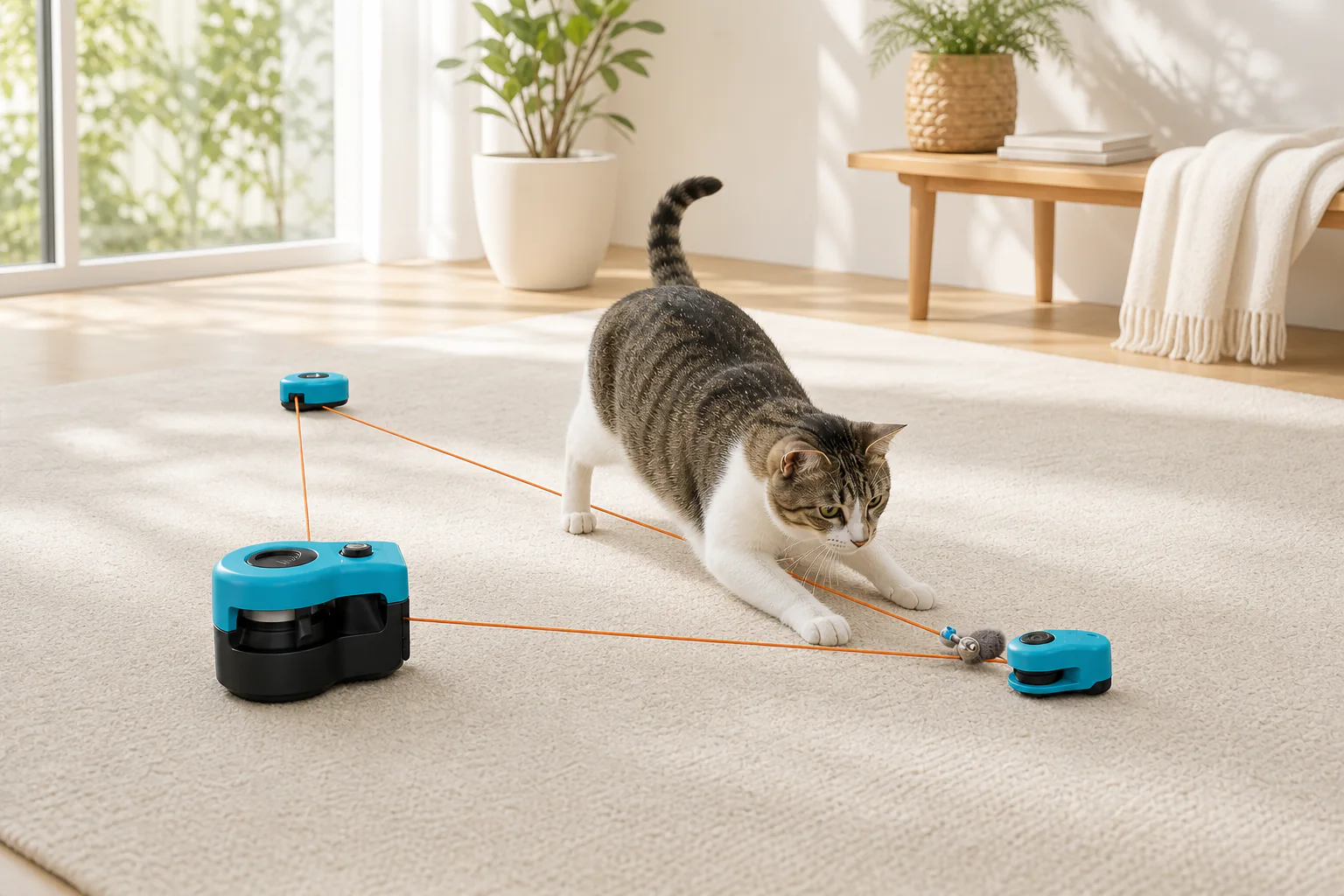
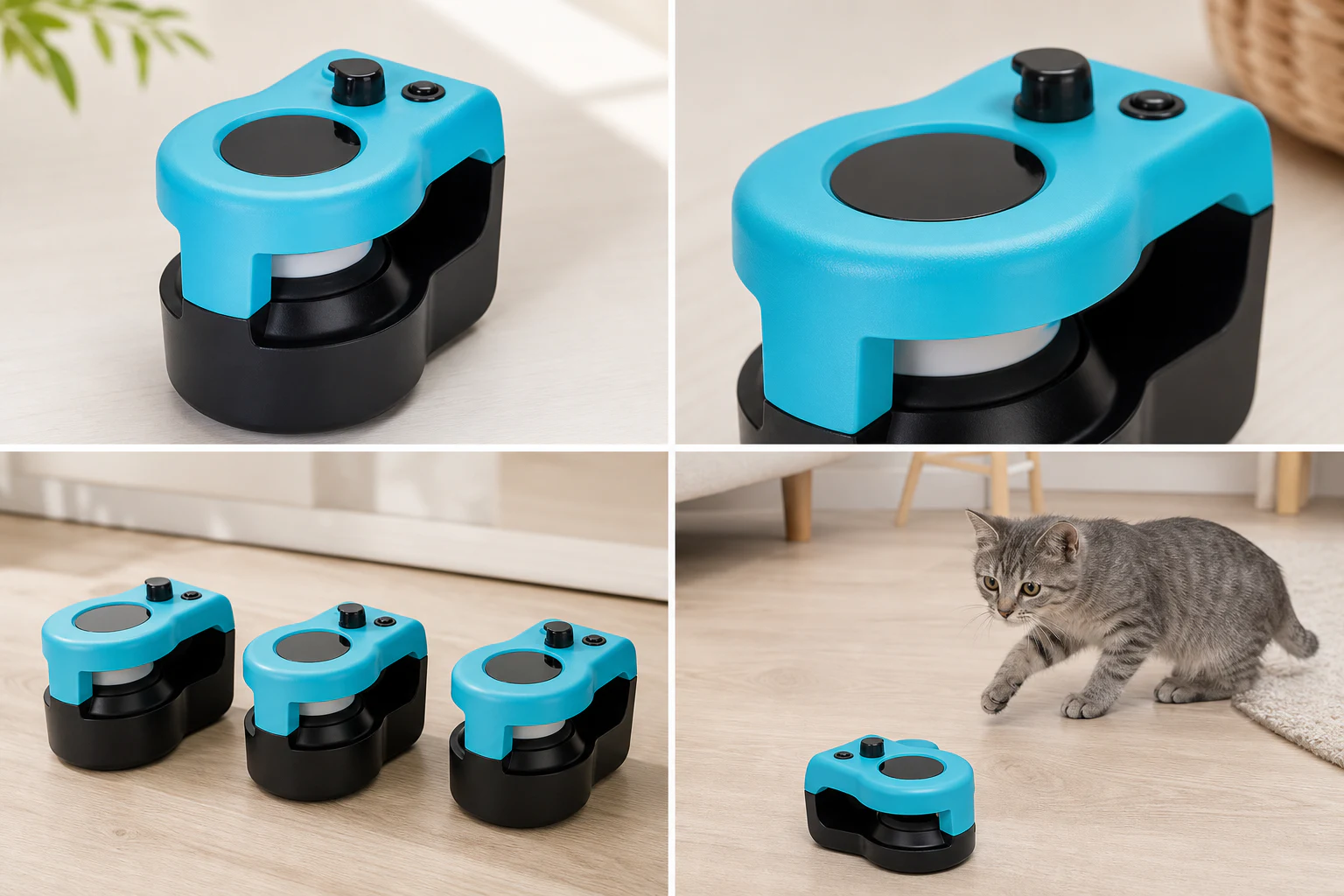
A rolling ball needs traction and a strategy for corners or furniture. A jumping ball needs stability and controlled motion. A flapping bird combines a motor with fabric, seams and detachable-looking features. A laser route introduces optical safety and labeling questions. A paired product such as CPC13400207 adds charging and communication behavior across two units.
Channel fit follows support capacity. A value retailer may prefer a simpler rechargeable rolling or flapping route with clear instructions. A pet-tech DTC brand may justify a paired interactive format if it can explain pairing, automatic mode, charging and replacement. Avoid building a twelve-SKU launch before the brand can support two or three mechanics well.
| Mechanic | Catalogue examples | First validation gate |
|---|---|---|
| Rolling | CPC13400228, CPC13400226, CPC13400196, CPC1340088 | Surface behavior, stall recovery, speed, shell integrity, detachable tail and charging. |
| Jumping | CPC130079 | Movement control, impact, noise, battery field and restart behavior. |
| Flapping / plush | CPC13400227, CPC13400215 | Seams, fibers, detachable pieces, motor enclosure, charging and cleaning boundary. |
| Laser | CPC13400231, CPC13400100 | Laser class/output evidence, labeling, beam path, shutdown and destination requirements. |
| Multi-function / paired | CPC13400230, CPC13400207 | Mode logic, unit pairing, battery identity, accessory count and customer instructions. |
Decision 02
How Should Motion and Durability Be Tested?
Use representative floors, obstacles and repeated cycles. Define stalls, uncontrolled movement, broken parts, abnormal sound, overheating and failure to enter or exit the intended mode.
A tabletop demonstration removes the actual environment. Test hard floor, low-pile carpet and the surfaces the listing will show. Add chair legs, a wall edge and low-clearance furniture. Record whether the toy stalls, becomes trapped, accelerates unexpectedly or repeatedly strikes the same object. If the product claims an automatic or intelligent mode, describe the rule and verify it over time.
Durability tests should follow the risk and target channel, not one generic drop number copied from another product. Inspect the shell, wheels, motor mount, charging port, tail connector, plush seams and any exposed screw or gap after repeated cycles and controlled impacts. For a paired product, test both units independently and together so one weak battery or communication failure is not hidden by the other.
Sound is a product characteristic and a pet-response variable. Record a comparable setup—distance, surface, room baseline, mode and battery level—rather than a subjective “quiet” label. A new mechanical sound after several cycles can be more informative than the initial reading.
| Stage | Test | Record |
|---|---|---|
| Start | Power, mode selection and low-battery behavior | Time to start, indicators, unexpected activation and instruction clarity. |
| Move | Hard floor, carpet, wall edge, furniture and pet-contact simulation | Stalls, impacts, speed changes, trapped state and recovery. |
| Pause / sleep | Leave undisturbed, then trigger the intended wake condition | Actual timing, false wakes and safe dormant state. |
| Charge | Approved cable/adapter, full cycle and repeated reconnects | Heat, port fit, indication, charge time and restart. |
| Inspect | Open only user-serviceable areas; inspect shell and attachments | Cracks, gaps, fibers, loose parts, noise and residue. |
Decision 03
What Small-Part, Fiber and Cleaning Questions Belong in Sampling?
Inspect what a cat can bite, pull, claw, lick or swallow. Then define which parts are consumable, replaceable, washable or never intended to be removed.
Interactive toys combine motion with close animal contact. A tail, feather, plush cover, silicone sleeve, wheel, cap or cable can fail differently from the main housing. Pull and twist attachments using a defined project method, inspect seams after repeated use and record the size and retention of any removable part. The exact test program must be selected for the product, market and intended user; this article does not certify a model.
Cleaning instructions need a boundary between the electronic body and removable accessories. If a plush cover can be washed, prove removal, drying and reattachment. If only wiping is allowed, test whether food, saliva and fur can be removed from gaps. Do not publish “washable” because one exterior material tolerates water while the charging port or motor does not.
Supervision wording should be realistic and visible. An interactive toy is not a substitute for observing a damaged product. The manual and packaging should tell the user to inspect for wear, stop use after damage and keep charging cables away from the animal. Market-specific warnings require review rather than a single English template for all regions.
- List every part the user can remove and every part the pet can plausibly detach.
- Inspect plush fibers, seams, glued decorations, tails, caps, wheels and charging-port covers.
- Define an end-of-test condition for wear before starting the cycle.
- Test cleaning using only the proposed consumer instructions.
- Match warnings and age/supervision language to the actual product and target market.
Decision 04
How Should Laser Cat Toys Be Evaluated?
Treat a laser model as a radiation-emitting product with its own evidence, labels and safe beam behavior. Never infer safety from color, visible brightness or the word “toy.”
The US FDA specifically includes laser cat toys in its laser-toy safety guidance. It warns against aiming a laser at people or animals and recommends that children's toy laser products stay within Class 1 limits. Product classification and the rules for a pet product must be confirmed for the exact model and market, but the sourcing lesson is clear: ask for the measured output, wavelength, class, labels, reports and beam-control behavior.
Test the beam path on reflective and non-reflective surfaces, power-up behavior, automatic shutdown and failure after impact. Confirm whether the beam can rest in one location or point above the intended floor zone. Do not use a bright demonstration video as evidence; the FDA notes that brightness is not a reliable indicator of power.
CPC13400231 and CPC13400100 are the catalogue laser routes. Their item records identify the shortlist, not an approved laser class. Until model-specific evidence is reviewed, public copy should describe them as catalogue-listed laser concepts and avoid “safe,” “eye-safe” or regulatory claims.
Decision 05
What Battery and Transport Evidence Should the Buyer Request?
Identify the exact cell and pack, watt-hour rating, protection, charging system and UN 38.3 test-summary availability. Then match the packed configuration to the applicable transport route.
Battery fields in mixed catalogues are prone to copy and unit errors. That is already visible in this range: CPC130079 contains an unclear output field and CPC13400207 uses a capacity unit where a current field is expected. Do not repair these values by guessing. Request the current cell/pack specification and update the item record at its source.
The US Pipeline and Hazardous Materials Safety Administration states that lithium cells and batteries offered for transportation must have passed the UN Manual of Tests and Criteria, Section 38.3 design tests, and that manufacturers must make a test summary available on request. Shipping rules vary by cell type, capacity and whether batteries are contained in or packed with equipment.
A brand should connect the battery document to the approved sample, carton contents and transport mode. Also test charging heat, low-battery behavior, cable fit, repeated connections and whether the toy enters an unexpected mode when power returns. Runtime needs a defined mode and duty cycle; a catalogue battery capacity alone cannot substantiate an hours-of-play claim.
| Area | Evidence / test | Release boundary |
|---|---|---|
| Identity | Cell and pack manufacturer, model, chemistry, capacity, voltage and watt-hours | Must match the approved product and packed configuration. |
| Protection and charging | Protection design, charger/cable specification and sample heat/behavior record | Do not approve a generic replacement cable or adapter by appearance. |
| Transport | Applicable UN 38.3 test summary and shipment classification/packing review | Confirm route with the shipper/carrier and current rules. |
| Runtime | Defined mode, surface, duty cycle, battery state and repeated sample results | Do not convert capacity into a runtime claim without testing. |
| End-user support | Low-battery indication, charge instructions, damaged-battery and disposal wording | Localize for the destination market. |
Decision 06
Why Must Catalogue Data Be Resolved Before Range Planning?
One item number must have one approved record. Repeated or contradictory catalogue values should stop the claim, not create a hidden choice between versions.
CPC13400191 illustrates the risk: it appears across three records with conflicting specifications and an implausible gross-weight value. If a team silently selects the best-looking fields, the website, quotation, packaging and inspection plan can describe different products. The result looks organized but is not controlled.
Create one item master for each shortlisted SKU. Record the source document, current specification revision, sample label, photo set, battery, materials, accessories, packaging and unresolved issues. Derived website and quotation text should come from that record. When a field changes, update the source and regenerate the dependent content rather than maintaining parallel facts.
This is also why twelve unique item numbers are presented instead of fourteen catalogue records. Repetition is preserved as evidence of a data-quality issue, not converted into artificial range size.
| Field group | Source of truth | Release rule |
|---|---|---|
| Identity | Item number, product name and approved sample label | No quotation without an exact match. |
| Mechanical | Dimensions, weight, material, mode and accessories | Conflicts remain visible until resolved. |
| Electrical | Battery, voltage/current, charging and runtime test | Units and packed configuration must agree. |
| Compliance / transport | Model-specific reports, summaries and market review | No generic transfer across unrelated items. |
| Public content | Approved claim register derived from the item master | Website and packaging cannot become independent data sources. |
Decision 07
What Should the Cat-Toy RFQ and Launch Shortlist Include?
Start with two or three mechanics and item numbers. Define the play behavior, materials, battery, target surfaces, channel, packaging, warnings and sample gates before discussing a full assortment.
A focused launch learns more than a twelve-SKU sample basket. Select one core movement route, one differentiated route and, only if the brand can support it, one laser or paired technology route. Use the same test template while preserving model-specific risk questions.
The RFQ should ask the supplier to correct disputed fields in writing and state what is not yet confirmed. Approve item records, test videos and packed samples together. For Amazon and DTC, convert the sample findings into listing boundaries, instruction images, troubleshooting and spare-accessory decisions before inventory ships.
- Item numbers and the exact movement or play-mode description.
- Target cat size/use context, surfaces, supervision and intended session.
- Materials, detachable accessories, cleaning and replacement scope.
- Battery identity, charging configuration, runtime test and transport documents.
- Laser evidence and labeling when a laser item is shortlisted.
- Destination market, quantity, color, packaging, languages and warning review.
- Explicit closure plan for every catalogue field marked for confirmation.
Buyer FAQ
Frequently Asked Questions
What should an interactive cat toy sample test include?
Test startup, movement on representative surfaces, stalls, impacts, pause/wake logic, sound, heat, charging, runtime under a defined cycle, cleaning, attachments, wear and the safe failure state.
Are laser cat toys safe?
Safety cannot be assumed. Review the exact model's output, wavelength, class, labels, beam behavior and destination-market requirements. The FDA warns never to aim a laser directly at a person or animal and notes that brightness does not indicate power.
Does a rechargeable cat toy need UN 38.3 evidence?
Lithium cells and batteries offered for transport generally must have passed the UN 38.3 design tests, and a test summary must be available on request. Confirm the exact cell, packed configuration, transport mode and current rules with the responsible shipping parties.
Why does the site show 12 cat-toy SKUs rather than 14?
The supplied catalogue has 14 product records but only 12 unique item numbers. Repeated records and conflicting fields are treated as data-quality issues rather than extra products.
What should an interactive cat toy RFQ include?
Include item numbers, play mechanic, target surfaces and use, materials, accessories, battery and charging, runtime method, laser evidence if relevant, destination market, quantity, packaging, warnings and disputed fields to resolve.
External validation
Research and Official References
Official sources define regulatory, safety, security, material or transport questions. Competitor sources show customer-support expectations. Neither proves model-specific LISO performance or compliance; those claims still require an approved sample, specification and project record.
- US FDA — Laser Toys: How to Keep Kids SafeOfficial safety guidance that explicitly includes laser cat toys and explains beam risks and Class 1 recommendations for children's toy lasers.
- US FDA — Frequently Asked Questions About LasersOfficial reference on laser hazards, labels and why visible brightness is not a power or safety measure.
- US PHMSA — Transporting Lithium BatteriesOfficial transport reference covering lithium-battery hazards and UN 38.3 test-summary availability.
- US PHMSA — Lithium Battery Guide for ShippersOfficial scenario-based guide for packaging and hazard-communication requirements; the exact shipment configuration controls.
- EUR-Lex — General Product Safety Regulation SummaryOfficial EU overview of risk analysis, technical documentation, traceability and economic-operator responsibilities for consumer products.