Direct answer
What Must a Private-Label Pet Camera Buyer Validate?
Before approving a private-label pet camera, map the complete product: device, firmware, mobile app, accounts, video storage, cloud services, updates and post-sale support. Then test password and sharing behavior, ownership transfer, privacy indicators, local versus cloud recording, data deletion, outage recovery and the promised support period. Finally, assign who is responsible for documentation and vulnerability handling in the United States, European Union and United Kingdom. A privacy-mode icon or a generic encryption claim is not a complete security review.
Verified starting point
What the Current LISO Catalogue Shows
- The current LISO catalogue contains seven item-numbered pet monitoring camera concepts.
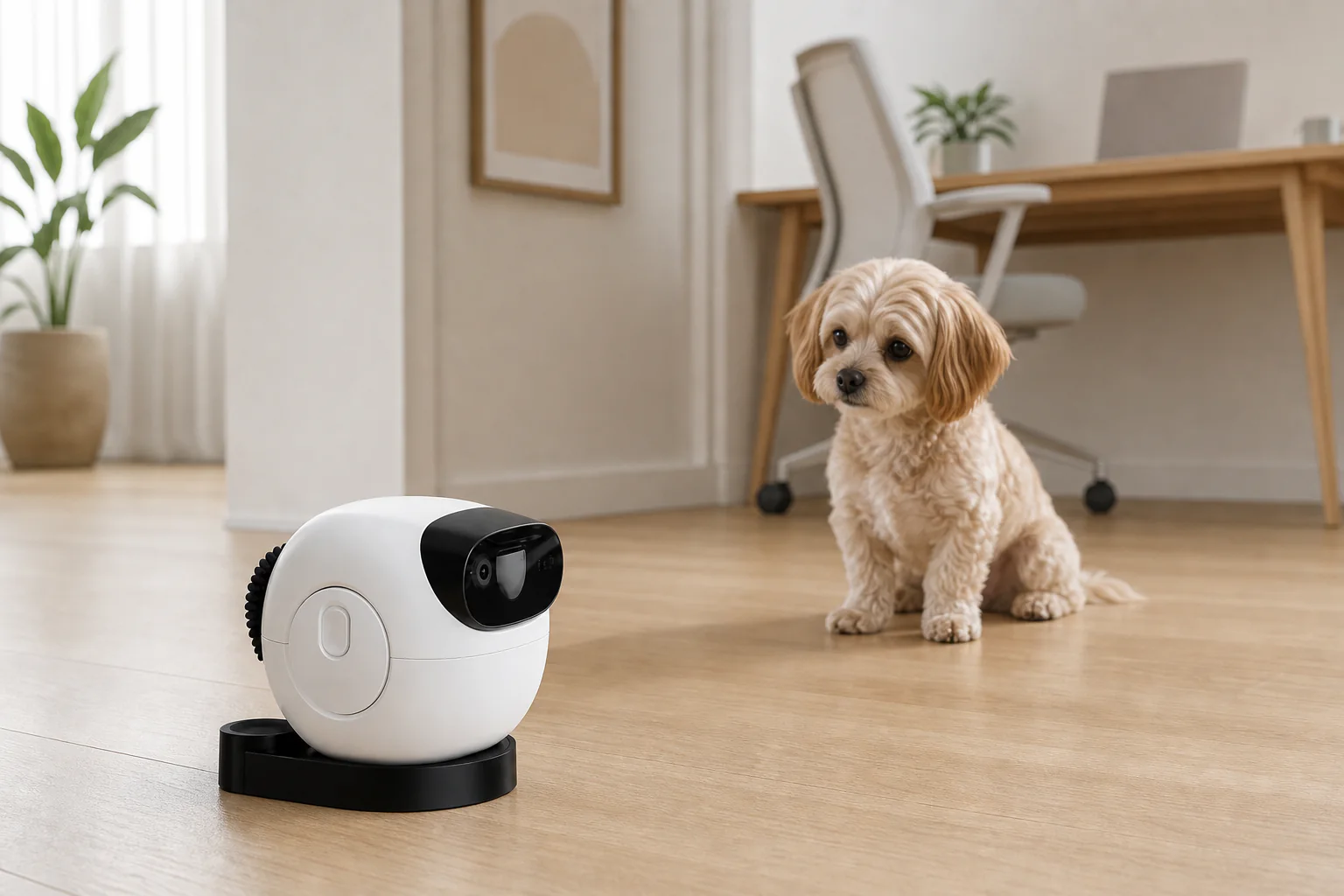
- CPC310019 is a movable dual-lens concept listing 1080p video, two-way communication, night vision, motion detection, AI humanoid tracking and a privacy mode; its catalogue height field requires confirmation.
- CPC310021 lists cloud plus offline recording and AP hotspot access, while CPC310026 lists one-click privacy masking and 360-degree coverage.
- CPC310022 lists 1296P / 3MP, and other models use different video, movement, storage or installation descriptions.
- No catalogue feature is treated as proof of legal compliance, encryption quality, data location, update duration or a final white-label app configuration.
Catalogue information is not a blanket certification or final production promise. Confirm the exact item and destination-market requirements before publication, quotation, or launch.
Decision 01
Why Must the Device and Cloud Be Reviewed as One Product?
The security boundary includes every component required for the promised function. A camera can have acceptable hardware while account recovery, cloud storage or an abandoned app creates the real customer risk.
Pet cameras operate inside homes, where video and audio may capture people as well as animals. NIST’s consumer IoT baseline evaluates the entire IoT product rather than only the physical device. That is the correct sourcing lens: device identity, configuration, data protection, interfaces, updates, security state and product documentation must work across hardware, firmware, app and supporting services.
For a private-label project, draw the data path before discussing cosmetic branding. Show what is recorded, where it is processed, whether storage is local, cloud-based or optional, which parties operate the app and cloud, which accounts can view the stream and what happens after a reset or resale. If the diagram cannot be completed, the privacy copy and support plan cannot be completed either.
The catalogue can identify candidates such as local/offline recording, privacy masking or AP hotspot access. It does not establish retention, encryption, authentication, server region, deletion or incident response. Those facts belong in the approved software and service specification.
| Layer | Buyer must identify | Failure if omitted |
|---|---|---|
| Device | Camera, microphone, indicators, reset, removable storage and physical privacy behavior | Marketing claims do not match what the user can see or control. |
| Firmware | Version, credentials, services, update method, support owner and recovery path | Known defects remain on shipped devices or updates break approved behavior. |
| App and accounts | Registration data, permissions, sharing, recovery, deletion and ownership transfer | Former or unintended users retain access; support cannot resolve account problems. |
| Cloud or local storage | Data types, route, location, retention, subscription and export/deletion behavior | The brand cannot explain where recordings go or what happens when service ends. |
| Operations | Monitoring, vulnerability intake, incident escalation, user notice and support period | Security becomes no one’s owned post-launch responsibility. |
Decision 02
Which Account and Access Tests Belong in the Golden Sample?
Test the full account lifecycle: first pairing, unique credentials, sharing, revocation, password recovery, device reset, ownership transfer and deletion. Confirm that indicators and app messages describe access accurately.
The FTC advises consumers to secure home cameras with strong unique passwords, multi-factor authentication when available, encrypted networks and current software. A B2B buyer should translate that guidance into product questions rather than repeating it as a marketing slogan. Does the device use universal or hard-coded credentials? Must a password be changed? Can a shared user invite another user? What happens to access when the owner removes the device?
Sharing is especially important for pet products because households may intentionally grant access to family members or sitters. The sample matrix should create at least three roles—owner, shared household member and temporary user—then test which actions each can perform. Revoke access and verify it on every device, not only in the owner’s interface.
A factory reset is not automatically an ownership-transfer process. Confirm whether reset deletes account binding, local media, Wi-Fi credentials and cloud associations, and whether the former owner receives a notice. Test an internet outage and app-service outage separately so users are not left with a camera that appears private while remote access remains ambiguous.
- Verify that no shared default password or hidden setup account grants unintended access.
- Pair, share, revoke, reset and re-pair the device using the final app build.
- Confirm visible recording, microphone, privacy and update states where applicable.
- Check whether removing the device also removes local and cloud associations.
- Test app permissions and notifications on target iOS and Android versions.
- Document support identity checks before an agent transfers or resets ownership.
Decision 03
How Should Local, Card and Cloud Storage Be Compared?
Compare customer outcome, not storage labels. Define what is recorded, who can retrieve it, how long it remains, what a subscription changes and how deletion works for local and remote copies.
Local or SD-card recording can reduce dependence on a subscription, but it creates questions about card compatibility, formatting, overwrite behavior, physical theft and playback. Cloud recording can provide remote history and event clips, but adds account, retention, billing, service-continuity and cross-border data questions. “Supports both” is not complete until each path is tested.
CPC310021’s catalogue listing of cloud plus offline recording makes it a useful candidate for this comparison; it is not evidence of a final service design. The buyer should request a screen recording of the exact app flow, format a target card, fill storage to the overwrite point, remove the network, restore it and confirm which events remain available.
Privacy copy must distinguish live viewing from recording. A user may disable cloud storage while live video still leaves the home, or enable a physical privacy mask while microphones or background services behave differently. The final manual and app need to describe those states without implying more protection than the implementation provides.
| Question | Local / SD route | Cloud route |
|---|---|---|
| What is stored? | Continuous or event clips, audio, thumbnails and device logs | Clips, thumbnails, alerts, metadata and account/service logs. |
| Who can retrieve it? | Physical card holder and authorized app roles | Authorized accounts, service operator and defined support roles. |
| What ends storage? | Card full, overwrite, removal, format or device reset | Retention limit, subscription end, deletion or account closure. |
| What happens offline? | Confirm recording and later playback behavior | Confirm missed events, queueing and user notification. |
| How is deletion proved? | Format and reset behavior on the exact sample | App deletion, account closure and service-policy behavior. |
Decision 04
What Do US, UK and EU Buyers Need to Allocate?
Allocate legal and operational ownership by market. Product rules differ and change over time, so the project record should name the responsible business, current requirements, evidence owner and next review date.
In the United Kingdom, the Product Security and Telecommunications Infrastructure regime applies duties to manufacturers, importers and distributors of covered consumer connectable products. The government’s guidance highlights baseline security requirements and a statement-of-compliance framework. A buyer should verify the exact scope and current regulations with qualified counsel rather than assume a generic supplier certificate closes the issue.
In the European Union, the General Product Safety Regulation has applied since 13 December 2024 and requires businesses to manage product safety, traceability and online-offer information. The Cyber Resilience Act entered into force in December 2024, but its main obligations apply from 11 December 2027; some reporting obligations start in September 2026. The correct 2026 action is readiness planning and current-law compliance—not claiming that every future CRA obligation already applies.
For the United States, NIST IR 8425 is a voluntary cybersecurity baseline, not a product approval. FTC consumer guidance and enforcement expectations make truthful security and privacy representations important. State privacy rules and other requirements may also apply depending on data, market and business role. The sourcing article cannot replace project-specific legal review.
| Market | Current planning anchor | Buyer action |
|---|---|---|
| United States | NIST consumer IoT baseline and truthful security/privacy representations | Map product capabilities, data claims, update ownership and applicable federal/state review. |
| United Kingdom | PSTI product-security duties for covered connectable products | Confirm role, scope, baseline requirements, statement and records for the exact product. |
| European Union | GPSR now; CRA phased application through 2027 | Maintain product-safety and traceability work now; build cybersecurity documentation, support and reporting readiness on the correct timeline. |
Decision 05
How Should a Buyer Compare the Seven Monitoring Concepts?
Shortlist by monitoring job and privacy architecture, then resolve catalogue anomalies before comparing cosmetic design. Fixed, movable, privacy-mask and local-recording routes should not share one generic specification.
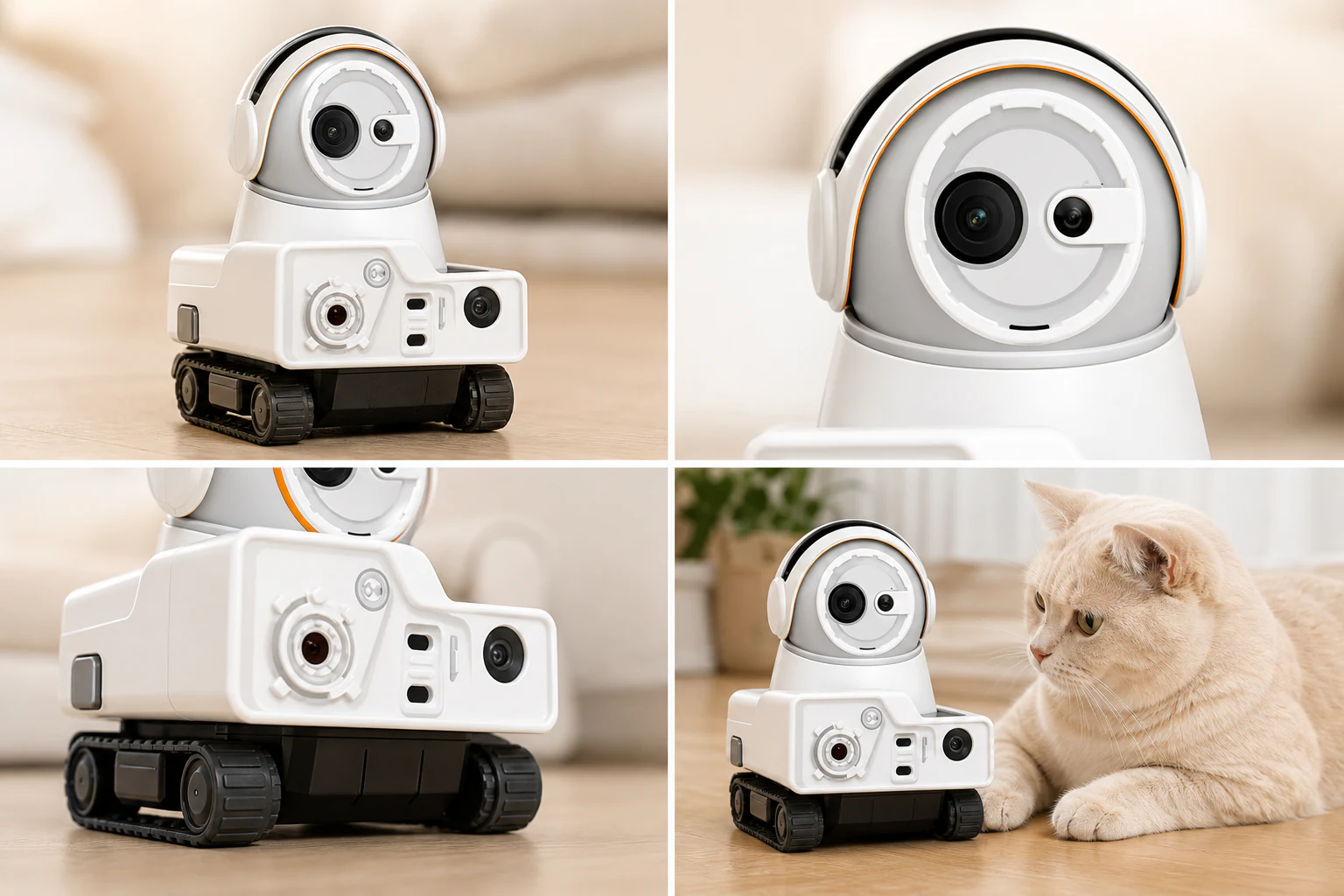
A movable camera such as CPC310019 adds motors, obstacle behavior, charging or power management and a changing field of view. A fixed camera can be easier to place and support, while CPC310026’s privacy-masking concept may offer a clearer user-controlled privacy story if the physical and software states are proven. CPC310021 is relevant when local/offline recording is central.
Do not select the highest stated resolution automatically. CPC310022 lists 1296P / 3MP, but customer value depends on low-light results, encoded stream, lens coverage, placement, storage and app display. Similarly, CPC310019’s catalogue height statement appears inconsistent with its product imagery and needs a current dimensioned specification before carton or listing copy is approved.
For every shortlisted model, create a claim register with four columns: catalogue statement, sample result, supporting document and approved public wording. If a row lacks evidence, it remains an RFQ question rather than becoming a product-page claim.
- Define whether the customer needs pet tracking, room monitoring, local recording, privacy masking or continuous recording.
- Resolve dimensions, power, battery and recording fields against a current specification.
- Record the final video at pet height in the intended room and lighting.
- Test privacy, reset and account states with the exact firmware and app build.
- Approve only public wording supported by the claim register.
Decision 06
What Security Evidence Should the RFQ Request?
Request an evidence map rather than a yes/no security questionnaire. Each promised capability should point to a test, document, version, owner and support period.
Security questionnaires often fail because the supplier can answer “yes” to encryption, updates or privacy mode without defining the protocol, scope or tested behavior. Ask for the architecture and evidence appropriate to the project: interfaces, credential behavior, update process, data flow, component inventory, vulnerability-contact route, logging and an end-of-support plan.
NIST IR 8425 also includes nontechnical capabilities such as documentation and information dissemination. That matters for Amazon and DTC sellers: a secure implementation still creates risk if users do not know how to update, reset, delete data or report a vulnerability. Include manual, support and incident communication in the same approval gate.
LISO can share project-appropriate test media and records when available, but catalogue text and generic factory images cannot prove cybersecurity. If a third-party report is required, define the exact model, firmware, test scope, laboratory and market purpose before treating the report as transferable.
| Capability | Evidence to request | Owner after launch |
|---|---|---|
| Credentials and access | Pairing, password, sharing, revocation, reset and ownership-transfer test record | App/service operator plus brand support. |
| Data protection | Data-flow diagram, interfaces, storage route and technical control description | Product owner and relevant service providers. |
| Updates | Signed/update process, rollback or recovery behavior, version record and support period | Firmware and app release owners. |
| Vulnerability handling | Contact, intake process, triage owner and user-notification route | Named manufacturer/brand/service roles. |
| Documentation | Secure setup, privacy states, deletion, update and end-of-support instructions | Brand content and support owners. |
Buyer FAQ
Frequently Asked Questions
Is a privacy mode enough for a pet camera?
No. Validate what privacy mode changes physically and digitally, whether audio or recording continues, what indicators show, which accounts can override it and how the state behaves after reboot or update.
Should a private-label pet camera use cloud or local storage?
Neither is universally better. Compare customer need, cost, retrieval, retention, subscription dependency, theft, outage, deletion, data-location and support responsibilities for the target market.
Does NIST IR 8425 certify a pet camera?
No. It is an official voluntary baseline for consumer IoT product cybersecurity outcomes. It helps structure questions but does not certify a specific LISO model.
Is the EU Cyber Resilience Act already fully applicable?
No. It entered into force on 10 December 2024. Reporting obligations begin on 11 September 2026 and the main obligations apply from 11 December 2027, subject to the regulation's detailed scope and transition rules.
What should a pet-camera RFQ include?
Include item numbers, monitoring job, target market, video and audio requirements, storage, account roles, privacy states, wireless setup, update and support period, app ownership, documentation, quantity, branding, plug and packaging.
External validation
Research and Official References
Official sources define regulatory, safety, security, material or transport questions. Competitor sources show customer-support expectations. Neither proves model-specific LISO performance or compliance; those claims still require an approved sample, specification and project record.
- NIST IR 8425 — Profile of the IoT Core Baseline for Consumer IoT ProductsOfficial US baseline covering technical and nontechnical cybersecurity outcomes for the complete consumer IoT product.
- US FTC — How to Secure Your Home Security CamerasOfficial consumer guidance on passwords, multi-factor authentication, secure networks, encryption and software updates.
- UK Government — PSTI Product Security FactsheetOfficial overview of UK duties for manufacturers, importers and distributors of covered consumer connectable products.
- European Commission — Cyber Resilience Act SummaryOfficial summary of roles, requirements and phased application dates for products with digital elements.
- EUR-Lex — General Product Safety Regulation SummaryOfficial EU summary covering product-safety, traceability, economic-operator and distance-sales responsibilities.
- UK ICO — Home CCTV SystemsOfficial public guidance illustrating that home cameras may capture other people's images and voices; applicability depends on use and jurisdiction.