Direct answer
How Should a Pet Brand Source a Silicone Lick Mat?
Source a silicone lick mat by approving the exact material formulation and food-contact evidence, then testing suction, texture, fill release, cleaning, dimensions, weight, odor, color and packaging on the production-intent sample. Decide whether the project is a simple private-label program on an existing mold or a new-tool ODM project. “Food grade,” “dishwasher safe” and “BPA-free” are not interchangeable claims and should not be published without evidence covering the exact formulation, color and intended use.
Verified starting point
What the Current LISO Catalogue Shows
- The current LISO catalogue contains two item-numbered silicone lick mat formats.
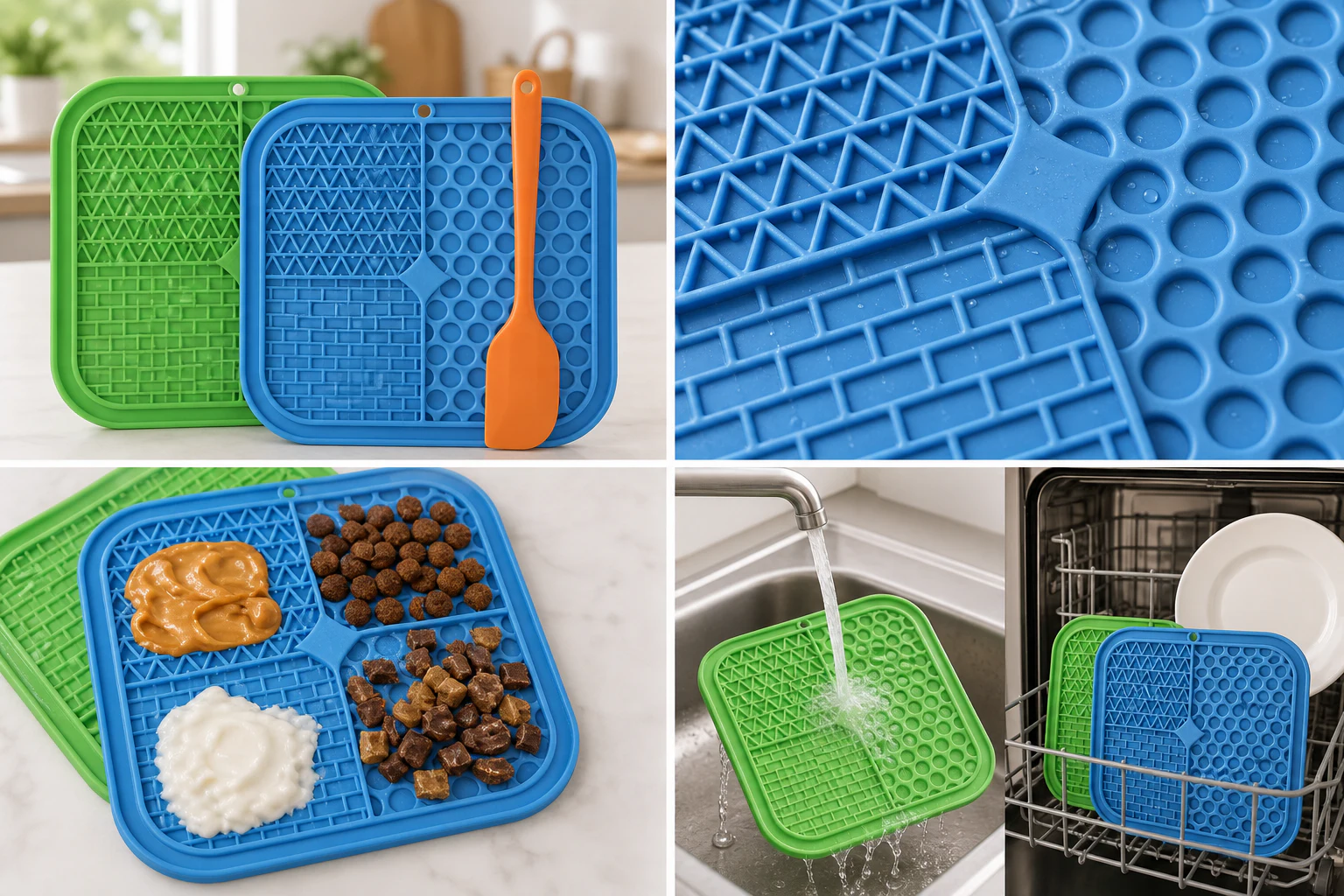
- CPD830010 is listed at 20 × 20 × 0.9cm and 135g, with selectable colors, customization, a food-grade statement and dishwasher/freezer/microwave descriptions.
- CPDBL231 is listed at 18.5 × 15.5 × 0.8cm and 60g, with blue, green and pink options, three compartments, suction cups and a food-grade statement.
- The catalogue establishes model concepts and listed claims. It does not by itself prove formulation, migration results, dishwasher cycles, microwave conditions, odor limits, suction performance or destination-market compliance.
- Any new color, additive, logo method or mold change must be checked against the approved material and product evidence rather than assumed covered.
Catalogue information is not a blanket certification or final production promise. Confirm the exact item and destination-market requirements before publication, quotation, or launch.
Decision 01
Which Lick Mat Format Fits the Range?
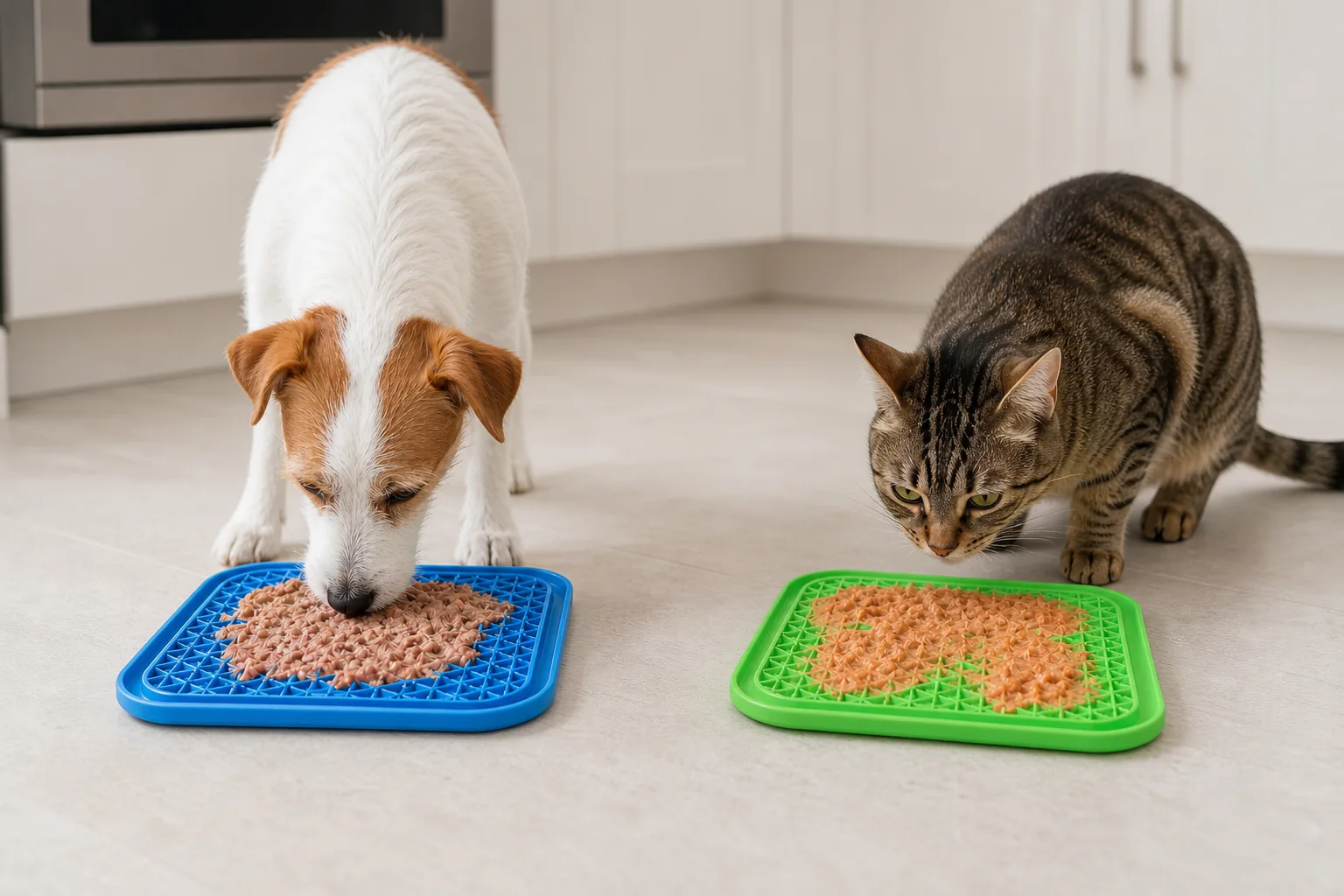
Choose by feeding job and price position. CPD830010 offers a heavier square format with more texture zones; CPDBL231 offers a lighter three-compartment and suction-led route.
The two catalogue models should not be sold as duplicates in different shapes. CPD830010 can support a more substantial enrichment and meal-spreading story, with a larger square footprint and multiple texture areas. CPDBL231 can support portion separation and a lighter add-on proposition, subject to confirming suction and packed-product feel.
The retail job determines the test. A freezer-use proposition needs low-temperature flexibility and cleaning checks. A bathing or grooming distraction proposition makes wall or vertical suction important. A daily feeding accessory needs repeated food-contact, odor, stain and cleaning evaluation. A bundle with a fountain or feeder may prioritize pack size and color coordination.
Consumer competitors such as SodaPup lead content with material safety, use cases and care instructions. That is a useful editorial pattern, but a B2B buyer must go one level deeper: which material declaration, test method, production color and mold version support each public claim?
| Item | Listed format | Possible range role | First release gate |
|---|---|---|---|
| CPD830010 | 20 × 20 × 0.9cm; 135g; multi-zone square | Core enrichment or meal-spreading mat | Material evidence, texture release, weight tolerance, cleaning and all temperature-use claims. |
| CPDBL231 | 18.5 × 15.5 × 0.8cm; 60g; three compartments and suction cups | Value add-on or portion-separated route | Suction on defined surfaces, wall/floor behavior, cleanability, packed deformation and material evidence. |
Decision 02
What Does Food-Contact Evidence Need to Cover?
Evidence should identify the exact material, color/formulation, part, intended contact conditions and market. A generic supplier statement or resin brochure is not enough to substantiate the finished colored mat.
The European Commission explains that food-contact materials placed on the EU market must comply with Regulation (EC) No 1935/2004 and be manufactured under applicable good manufacturing practice. Silicone elastomers may also involve national or other applicable measures, so the buyer needs destination-specific review rather than assuming one harmonized “EU silicone certificate” answers every question.
In the United States, 21 CFR 177.2600 addresses rubber articles intended for repeated food contact under specified conditions and extraction limits. Whether a particular lick mat and formulation complies requires evidence and expert review; the regulation is not an automatic FDA approval for any product called silicone.
Color matters because pigments and additives can change the formulation. Ask whether the declaration or test covers the selected blue, green, pink or custom color, the finished article and the intended time/temperature/contact conditions. If a logo is molded, printed or otherwise applied to a contact surface, include that process in the review.
| Evidence field | Buyer question | Claim boundary |
|---|---|---|
| Material identity | What exact elastomer, additives and pigments make the finished article? | Do not use “100% silicone” unless documented for the finished mat. |
| Article and color coverage | Does the report cover this model, thickness, pigment and production process? | One color or raw-material report may not cover a custom version. |
| Contact conditions | Which foods/simulants, time, temperature and repeated-use conditions were assessed? | Dishwasher, freezer or microwave claims require their own evidence and instructions. |
| Market and method | Which regulation, standard, laboratory and report date apply? | Avoid a generic “FDA approved” or “EU certified” statement. |
| Change control | What triggers review when resin, pigment, tool or supplier changes? | Old evidence cannot remain the source of truth after an uncontrolled change. |
Decision 03
How Should Texture, Suction and Feeding Use Be Tested?
Test target foods on defined surfaces and temperatures. Measure whether the mat stays in place, releases food as intended and can be cleaned without trapped residue or damaged suction cups.
Select representative wet food, spreadable treat and one thicker or particulate recipe the target customer is likely to use. Record fill weight, spreading time, removal after a defined session and residue after cleaning. The purpose is not to prove a health benefit; it is to understand how geometry changes the user experience.
Suction is surface-dependent. Test clean dry tile, smooth glass or another intended surface, then repeat with a lightly wet surface and after multiple wash cycles. Record the force or practical method used, dwell time and failure definition. A mat that adheres horizontally may not remain secure on a wall; do not use one result for both claims.
Inspect the back and edges after flexing, freezing and the approved cleaning cycle. Check warp, tears, whitening, odor and whether the mat lies flat again. If microwave or dishwasher use is proposed, define the appliance conditions, duration and number of cycles rather than applying a blanket icon from the catalogue.
| Property | Test setup | Record |
|---|---|---|
| Food release | Target wet/spreadable/particulate foods and defined fill weight | Spreading, access, remaining food and texture-specific behavior. |
| Suction | Defined smooth surfaces, dry/wet condition and horizontal/vertical orientation | Dwell time, movement, peel behavior and failed cups. |
| Cleaning | Approved hand/dishwasher route for repeated cycles | Residue, odor, stain, deformation and damaged texture. |
| Temperature | Only the claimed freezer/microwave conditions | Flexibility, shape, odor and visible damage after conditioning. |
| Durability | Repeated flex, edge handling and packed-storage simulation | Tears, whitening, warp, flatness and surface changes. |
Decision 04
Which Claims Need Separate Proof?
Control each claim independently. “Food-contact suitable,” “BPA-free,” “dishwasher safe,” “freezer safe,” “microwave safe,” “non-slip” and “durable” describe different facts.
Marketing pages often stack safety and care terms into one badge strip. That creates a false impression that one report proves every term. A formulation may meet a repeated food-contact requirement but still deform under an untested dishwasher program. A mat may contain no intentionally added BPA but still lack a documented basis for a broad “chemical free” claim.
Create a claim register with the exact wording, model/color, evidence, test condition, approving person and review date. If the evidence supports only one temperature or cycle, the instructions should state it. If evidence is missing, remove or qualify the claim rather than treating the catalogue icon as proof.
Avoid therapeutic language. A lick mat may be positioned as an enrichment or feeding accessory, but claims that it treats anxiety, changes behavior or produces health outcomes need a different evidence and regulatory review. The safest content explains the physical design, use and supervision instead of promising a medical result.
Decision 05
How Should Existing-Mold OEM and New-Mold ODM Be Separated?
Use an existing mold for lower-risk branding, color and packaging work. Treat a new texture, shape or suction geometry as a tooling project with separate design, evidence, samples, schedule and ownership.
The current catalogue lists customization on CPD830010, and the owner-confirmed general program supports logo, color and packaging work subject to the exact model. For a first Amazon or DTC launch, an existing mold with an approved color, retail box and instruction set is usually easier to validate than a new geometry.
A molded logo can affect cleaning or food-contact surfaces depending on placement. A custom pigment can change evidence scope. A new box can deform a soft mat if folding or compression is not tested. Even “simple” OEM therefore needs an approved artwork, color standard, packed sample and claim review.
A new mold is heavy ODM. It changes texture release, thickness, weight, suction, draft, tear risk, packed dimensions and potentially the required tests. Owner guidance indicates private tooling can add roughly 30–45 days as a planning reference, but the actual schedule and MOQ depend on design maturity, mold complexity, sample rounds and production capacity. Do not publish a fixed figure before quotation.
| Change | Project class | Approval focus |
|---|---|---|
| Logo on packaging / non-contact area | Simple private label | Artwork, placement, durability and claim control. |
| Existing approved color | Simple OEM | Color standard, tolerance and evidence coverage. |
| New pigment | OEM with material review | Formulation, finished-article evidence, color stability and odor. |
| Retail box / bundle | Packaging localization | Claims, warnings, languages, deformation, barcode and packed inspection. |
| Molded logo, new texture or suction layout | ODM / tooling change | Food-contact surface, cleanability, performance, mold approval and ownership. |
| Entirely new shape or mold | Heavy ODM | Design file, tooling, sample rounds, evidence, MOQ, schedule and change control. |
Decision 06
What Packaging and Production Details Affect the Finished Mat?
Soft silicone can attract dust, retain odor, deform in tight packaging or pick up marks. Approve the packed product after storage simulation, not only the loose golden sample.
Review how the mat is cleaned before packing, protected from dust and separated from printed materials. Check whether folding creates a persistent crease, whether color transfers, whether the product regains flatness and whether the package lets the buyer understand dimensions and texture. A compact carton can reduce freight while creating an unattractive first-use product.
Set measurable appearance boundaries for specks, flash, short shots, bubbles, sink, color difference, odor and deformation. The exact plan should reflect the process and market rather than copying a hard-plastic inspection sheet. Retain approved color and surface samples under controlled conditions.
Instructions should show spreading, supervision, inspection for damage, cleaning, drying and the exact allowed temperature uses. If a claim changes, update packaging, listing and manual from the same approved register so derived content never becomes a competing source of truth.
- Approve a loose sample and a fully packed sample after the intended storage period.
- Define color with a physical or controlled standard, not a screen image alone.
- Set inspection boundaries for flash, bubbles, specks, odor, warp and suction defects.
- Verify all claims and warnings on packaging, manual and online listing from one register.
- Preserve customer mold, artwork and confidential project information while sharing only approved generic evidence.
Decision 07
What Should a Silicone Lick Mat RFQ Include?
Name the item, use case, market, formulation/evidence expectations, color, logo method, packaging, quantity and sample tests. State clearly whether the project uses an existing mold or requires new tooling.
For an existing-mold program, shortlist CPD830010 or CPDBL231 and specify target foods, use orientation, color, branding location, package, destination markets, expected quantity and documentation questions. Ask for the current sample and evidence scope before finalizing public claims.
For a tooling project, add dimensioned design, texture objective, suction surfaces, thickness, target weight, mold ownership, development milestones and the evidence plan. Commercial terms are project-dependent; neutral samples, simple OEM and new molds should not share one public MOQ or lead time.
- Exact item number or controlled new-product drawing.
- Feeding use, target foods, surfaces and temperature-use claims.
- Material, pigment and finished-article evidence by destination market.
- Logo method, color standard, packaging, languages and warning review.
- Suction, texture, cleaning, temperature and packed-storage sample matrix.
- Quantity, launch market, channel and required delivery window.
- Existing-mold versus new-mold scope, ownership and change control.
Buyer FAQ
Frequently Asked Questions
Does food-grade silicone mean a lick mat is certified for every market?
No. Ask what exact formulation, color, finished article, contact condition, test method and market the evidence covers. A generic phrase or raw-material report is not universal finished-product approval.
Can a lick mat be called dishwasher, freezer and microwave safe?
Only when the exact model and formulation have been validated under defined conditions and the instructions state those limits. The three claims are separate and should not be inferred from one material name.
What is the difference between the two LISO lick mats?
CPD830010 is a 20cm square, 135g multi-texture format. CPDBL231 is a lighter 18.5 × 15.5cm three-compartment format with listed suction cups. Both require sample and evidence confirmation.
Can LISO make a custom lick mat mold?
New-mold ODM can be discussed, but it is a heavier project with higher MOQ, longer development, tooling and separate validation. Exact feasibility, ownership, cost and schedule require a controlled design and quotation.
What should a private-label lick mat RFQ include?
Include item number or drawing, target use and foods, market, material evidence, color, logo method, packaging, quantity, suction/cleaning/temperature tests and whether an existing or new mold is required.
External validation
Research and Official References
Official sources define regulatory, safety, security, material or transport questions. Competitor sources show customer-support expectations. Neither proves model-specific LISO performance or compliance; those claims still require an approved sample, specification and project record.
- European Commission — Food Contact MaterialsOfficial EU overview of the framework regulation and good-manufacturing-practice requirements for food-contact materials.
- eCFR — 21 CFR 177.2600 Rubber Articles Intended for Repeated UseOfficial US regulatory text for specified repeated-use rubber food-contact articles; exact product applicability and compliance require evidence and review.
- EUR-Lex — General Product Safety Regulation SummaryOfficial EU summary covering product risk analysis, technical documentation, traceability and business responsibilities.
- SodaPup — Lick Mat Material Safety GuideCompetitor editorial benchmark for consumer questions about material and care; its claims do not validate a LISO material or finished product.